Can I Drink Alcohol on Semaglutide Safely? Your 2026 Evidence-Based Guide
There's no proven semaglutide-specific alcohol limit. If you drink, keep it light, drink with food, go easy during dose increases, and watch for low blood sugar—especially if you also use insulin or a sulfonylurea.
This article is for general informational purposes only and is not a substitute for professional medical advice, diagnosis, or treatment. Always consult a qualified healthcare provider with questions about a medical condition.
The Question Nobody Wants to Ask Their Doctor
You've been on Ozempic for three months, lost 18 pounds, and your friend just invited you to a wine tasting in Napa. Your first thought isn't about the scenery. It's: will two glasses of Pinot wreck everything I've worked for?
You're not alone. Many people on GLP-1 medications wonder about alcohol but feel awkward bringing it up with their prescriber. The silence is understandable. Asking feels like admitting you're not taking your health seriously. But here's the thing—understanding how alcohol interacts with semaglutide isn't about finding loopholes. It's about making informed decisions with your eyes open.
Let's dig into what the research actually shows.
What Happens in Your Body When GLP-1s Meet Alcohol
Semaglutide works by mimicking a hormone called GLP-1, which does several things simultaneously. It signals your brain that you're full. It slows down how fast food leaves your stomach. And it helps your pancreas release insulin more effectively when blood sugar rises.
Alcohol enters this system like an uninvited guest at a dinner party.
Semaglutide delays early post-meal gastric emptying: a randomized crossover study found slower emptying in the first hour after a meal (Hjerpsted et al., 2018), although a 20-week study of the 2.4 mg dose found no clear delay over five hours (Friedrichsen et al., 2021). How this changes alcohol absorption hasn't been measured directly. In theory, slower and more variable stomach emptying could make alcohol's effects less predictable—you might not feel it as quickly, then feel it more than you expected.
The Liver Factor Most People Miss
Semaglutide and alcohol are broken down in different ways—and this is where things get interesting.
According to its prescribing information, semaglutide is eliminated mainly through proteolytic cleavage of its peptide backbone and beta-oxidation of its fatty-acid side chain—not through the cytochrome P450 enzymes that handle most drugs. Alcohol, by contrast, is processed mainly by the liver. So there's no known direct enzymatic competition between the two.
But "no direct interaction" doesn't mean "no concerns."
People on GLP-1 medications often have underlying metabolic conditions. A global meta-analysis estimated that 55.5% of people with type 2 diabetes have non-alcoholic fatty liver disease (Younossi et al., 2019). Add alcohol to an already stressed liver, and you're asking more from an organ that's already working overtime.
What the Research Actually Shows (and Doesn't)
Let's talk specifics, because vague warnings help nobody.
Here's the honest picture: there's no large controlled study measuring blood alcohol levels or hangovers in people taking semaglutide. What we do have:
- Semaglutide delays stomach emptying mainly in the first hour after a meal (Hjerpsted et al., 2018)
- In a small randomized trial in adults with alcohol use disorder, low-dose semaglutide reduced the amount of alcohol consumed in a lab drinking session and drinks per drinking day (Hendershot et al., 2025)
- Semaglutide alone has a low risk of hypoglycemia, but the risk rises when it's combined with insulin or a sulfonylurea (prescribing information)
Alcohol also brings its own hypoglycemia risk. The American Diabetes Association's Standards of Care advise that people with diabetes who drink be educated about delayed hypoglycemia after drinking, especially when they use insulin or insulin secretagogues such as sulfonylureas.
Put together, these findings point to practical caution rather than a precise semaglutide-specific limit.
Practical Guidelines That Actually Make Sense
Based on the current evidence, here's what reasonable alcohol consumption looks like on semaglutide:
For most people: There's no semaglutide-specific safe limit. If you drink, general guidance applies: US dietary guidance has defined moderate drinking as up to one drink a day for women and two for men, and less is better. A standard drink means 12 ounces of beer, 5 ounces of wine, or 1.5 ounces of spirits.
Timing matters: Drinking with food—not on an empty stomach—may reduce blood sugar swings and nausea.
The first month is different: Your body is still adjusting to semaglutide during dose escalation, when nausea and GI side effects are most common. It's sensible to skip alcohol or keep it minimal until those settle. Adding alcohol to an already unsettled stomach is asking for trouble.
Know your baseline: If you have fatty liver disease, take other medications metabolized by the liver, or have a history of hypoglycemia, your threshold is lower. Possibly much lower.
The Hypoglycemia Risk Nobody Explains Properly
Here's something that trips people up: semaglutide alone rarely causes hypoglycemia. But alcohol absolutely can.
When you drink, your liver prioritizes metabolizing ethanol over producing glucose. This can cause blood sugar to drop, sometimes hours after your last drink—often while you're sleeping. Semaglutide's insulin effect is glucose-dependent, which is why it rarely causes lows on its own; the bigger danger is combining alcohol with other glucose-lowering drugs.
The risk is highest if you're also taking sulfonylureas or insulin alongside your GLP-1. The prescribing information warns that these combinations increase the risk of hypoglycemia, including severe hypoglycemia, and that the dose of those drugs may need to be lowered.
This isn't meant to scare you into complete abstinence. It's meant to explain why "just have a snack before bed" is actually important advice, not just something doctors say to cover themselves.
What Changes at Different Doses
Semaglutide dosing ranges from 0.25mg (starting dose) to 2.4mg (weight management dose). Does the dose affect alcohol tolerance?
There's no direct data on alcohol tolerance by dose.
What we do know is that GI side effects are most common around dose increases. The practical implication: if you've recently increased your dose, your previous sense of how alcohol affects you may no longer apply—start with less.
The Weight Loss Angle
Something interesting happens to alcohol's appeal on GLP-1 medications.
Some people report that alcohol simply doesn't appeal as much anymore. In a survey study, people with obesity taking semaglutide or tirzepatide reported drinking less, fewer drinks per episode, and lower odds of binge drinking compared with before starting and with a control group (Quddos et al., 2023). In a small randomized trial in adults with alcohol use disorder, low-dose semaglutide reduced lab alcohol intake, drinks per drinking day, and craving (Hendershot et al., 2025). And in an fMRI study, the related drug exenatide reduced alcohol cue reactivity in the brain's reward areas (Klausen et al., 2022).
This isn't universal. Some people report no change in alcohol desire. But if you find yourself less interested in that second drink, you're not imagining it. Your brain chemistry has genuinely shifted.
From a pure calorie perspective, alcohol can also undermine weight loss. At 7 calories per gram (almost as dense as fat), a bottle of wine adds roughly 600 calories. And because the body prioritizes clearing alcohol, fat burning is temporarily put on hold while you drink.
When to Avoid Alcohol Completely
Some situations call for complete abstinence, at least temporarily:
- During dose escalation phases when GI side effects are unpredictable
- If you're experiencing persistent nausea or vomiting from the medication
- Before medical procedures or blood work (alcohol can affect multiple lab values)
- If you're on multiple diabetes medications, especially sulfonylureas or insulin
- If you have documented liver disease beyond mild fatty liver, or a history of pancreatitis (GLP-1 labels warn about acute pancreatitis, and heavy drinking is a common cause of it)
- If you've had previous episodes of hypoglycemia
This isn't about moral judgment. It's about recognizing when the risk-benefit math doesn't work in your favor.
Having the Conversation With Your Provider
If you've been avoiding this topic with your doctor, here's a script that might help:
"I want to be honest about my alcohol use so we can make sure my treatment is safe. I typically drink [specific amount] per [week/month]. Are there specific limits I should follow on semaglutide, and what warning signs should I watch for?"
Most providers will appreciate the directness. They'd rather have accurate information than assume you're not drinking when you are.
The Bottom Line
Can you drink alcohol on semaglutide? The prescribing information doesn't prohibit it, and there's no evidence-based rule that everyone must abstain—but there's also no proven safe limit specific to semaglutide.
So "okay" comes with asterisks. Your tolerance may have changed. Effects may hit differently. Nausea is more likely the more you drink. Hypoglycemia is a real concern, especially overnight and if you also take insulin or a sulfonylurea. And your liver deserves consideration even when direct drug interactions aren't the issue.
The smartest approach isn't prohibition—it's recalibration. Learn your new limits gradually. Eat before drinking. Stay well under what you think you can handle, at least initially. And if something feels off, trust that instinct.
Your body is different now. Respect that, and you can probably still enjoy that wine tasting.
📊 Key Stats
Drinking Situations on GLP-1 Therapy
| Situation | Main concern | Practical guidance |
|---|---|---|
| Occasional light drinking, no insulin or sulfonylurea | Nausea; effects may feel less predictable | Drink with food; start with less than usual |
| During dose escalation | GI side effects are most common | Skip or minimize alcohol until symptoms settle |
| Also taking insulin or a sulfonylurea | Hypoglycemia, including delayed and overnight lows | Discuss limits with your prescriber; eat and monitor glucose |
| Liver disease or history of pancreatitis | Added liver strain; alcohol is a common cause of pancreatitis | Ask your clinician whether to avoid alcohol |
| Heavy or binge drinking | Hypoglycemia, dehydration with GI symptoms, liver stress | Avoid; seek support if cutting down is hard |
General guidance based on prescribing information and diabetes care recommendations; not a substitute for individual medical advice.
❓ Frequently Asked Questions
Will one glass of wine ruin my semaglutide dose?
Why do I feel drunker on the same amount of alcohol now?
Can I drink during my first month on semaglutide?
Is beer, wine, or liquor safer on GLP-1 medications?
Should I skip my semaglutide dose if I plan to drink heavily?
What are the warning signs of hypoglycemia after drinking?
Does semaglutide reduce alcohol cravings?
What is HAVIT?
HAVIT is an AI health partner built on metabolic science — it protects your muscle, wakes up your metabolism, and helps you keep a healthy, rebound-free body for the long run.
Unlike calorie-only trackers, HAVIT connects AI body-composition estimates, nutrition, hydration, sleep, steps, cycle, mood, and GLP-1 medication in one daily routine — so progress is measured by body composition, not just the number on the scale. Daily missions turn established behavior-change techniques into small repeatable actions, drawing on expertise from professionals formerly at Juvis Diet, one of Korea’s leading metabolic clinics.
In HAVIT’s own analysis of 1,090 GLP-1 users, people who logged consistently built stronger habits than the general user base. Read the GLP-1 Habit Report
Inside the app
- AI COACHA coach that reads your day.
- WORKOUT & RUNNINGFrom home workouts to your next run.
- NUTRITIONLog meals in seconds.
- BODY INSIGHTSSee more than weight.
- DAILY MISSIONSBuild habits you can repeat.
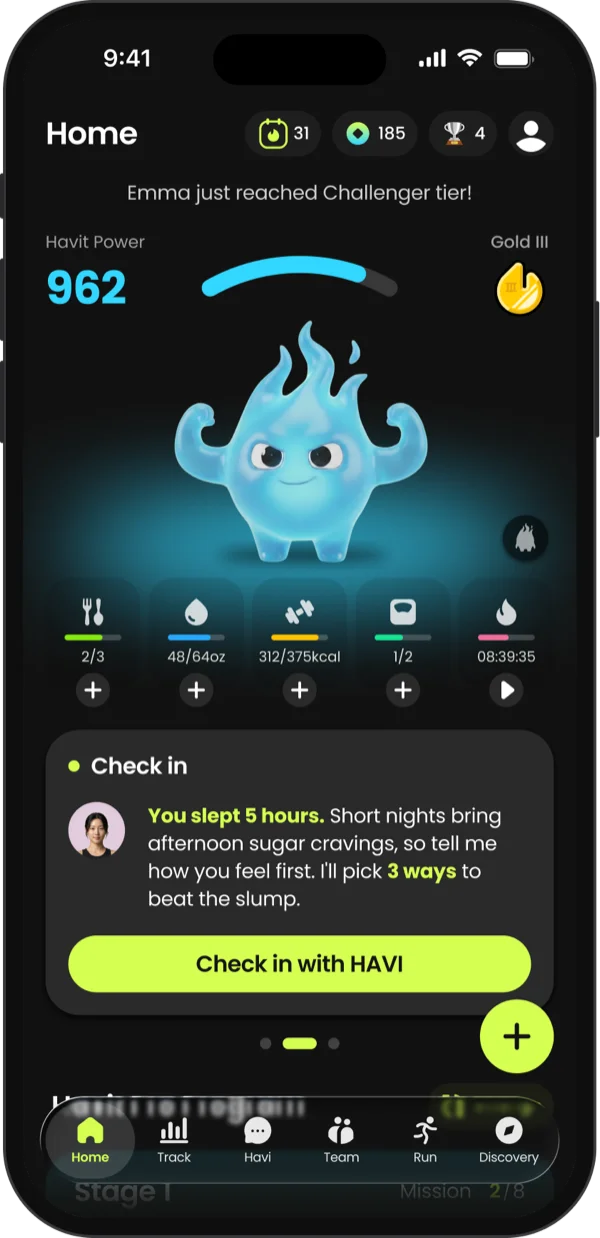
- DAILY CHECK-INTell HAVI how today feels.
- TRACK EVERYTHINGFrom water to GLP-1
- MIND & RECOVERYFor the days willpower runs out.


HAVIT works with or without GLP-1 medication. It is a wellness app, not a medical device; body-composition results are estimates.

Continue in the App
Personalized wellness with your own data


References
- Semaglutide improves postprandial glucose and lipid metabolism, and delays first-hour gastric emptying in subjects with obesity — Diabetes, Obesity and Metabolism, 2018
- The effect of semaglutide 2.4 mg once weekly on energy intake, appetite, control of eating, and gastric emptying in adults with obesity — Diabetes, Obesity and Metabolism, 2021
- OZEMPIC (semaglutide) injection — Prescribing Information — Novo Nordisk (U.S. FDA-approved labeling)
- 5. Facilitating Positive Health Behaviors and Well-being to Improve Health Outcomes: Standards of Care in Diabetes—2025 — Diabetes Care, 2025
- The global epidemiology of NAFLD and NASH in patients with type 2 diabetes: A systematic review and meta-analysis — Journal of Hepatology, 2019
- Once-Weekly Semaglutide in Adults With Alcohol Use Disorder: A Randomized Clinical Trial — JAMA Psychiatry, 2025
- Semaglutide and Tirzepatide reduce alcohol consumption in individuals with obesity — Scientific Reports, 2023
- Exenatide once weekly for alcohol use disorder investigated in a randomized, placebo-controlled clinical trial — JCI Insight, 2022