
Best Body Composition Tracking Apps in 2026: The Accuracy Ladder

This article is for general informational purposes only and is not a substitute for professional medical advice, diagnosis, or treatment. Always consult a qualified healthcare provider with questions about a medical condition.
Quick answer
DEXA and InBody measure; smart scales and apps estimate. An estimate that is consistently wrong still tracks change correctly — right for "is this costing me muscle?", wrong for "what is my body fat percentage?"
If you need a number you can take to a clinician, stop reading and book a DEXA scan. No app is that.
If you want to know whether the weight you are losing is fat or muscle, week over week, a consumer tool is genuinely useful — provided you understand what it is doing.
This guide takes the methods and apps one at a time.

01
First — the accuracy ladder
| Rung | Method | Measures or estimates | What moves the number |
|---|---|---|---|
| 1 | DEXA | Measures (reference standard) | Very little |
| 2 | Multi-frequency BIA (InBody and similar) | Measures | Hydration, food, exercise, time of day |
| 3 | Smart scale · smartwatch BIA | Measures (foot-to-foot / hand-to-hand) | Everything in rung 2, plus contact quality |
| 4 | App estimate (survey or photo model) | Estimates | Input quality, model assumptions |
Rungs 1 and 2 measure. Rungs 3 and 4 estimate. That distinction is the whole article.
An estimate that is consistently wrong in the same direction still tracks change correctly — right for "is this diet costing me muscle?", wrong for "what is my body fat percentage?"
02
Why composition instead of weight
Scale weight moves with water, glycogen, sodium and cycle.
It matters most on GLP-1 therapy (Wegovy, Ozempic, Mounjaro, Zepbound): the lean-mass share of weight lost has been reported at 40–60% in some trials and 15% or less in others.
A scale reports all of it as success. Lean mass is not identical to muscle — it also counts organs, bone and fluid — but either way the scale cannot show you which end you are on.

03
HAVIT — the trend, with something attached to it
| Rung | 4 (survey-based AI estimate) |
| Hardware | None |
| Validation | Internal comparison against InBody, n=70, published |
| Read alongside | Meals, hydration, workouts, sleep, steps, cycle, mood, GLP-1 |
| Price | Free · in-app purchases |

The number is not the point. What sits next to it is.
A smart scale gives you a figure and stops.
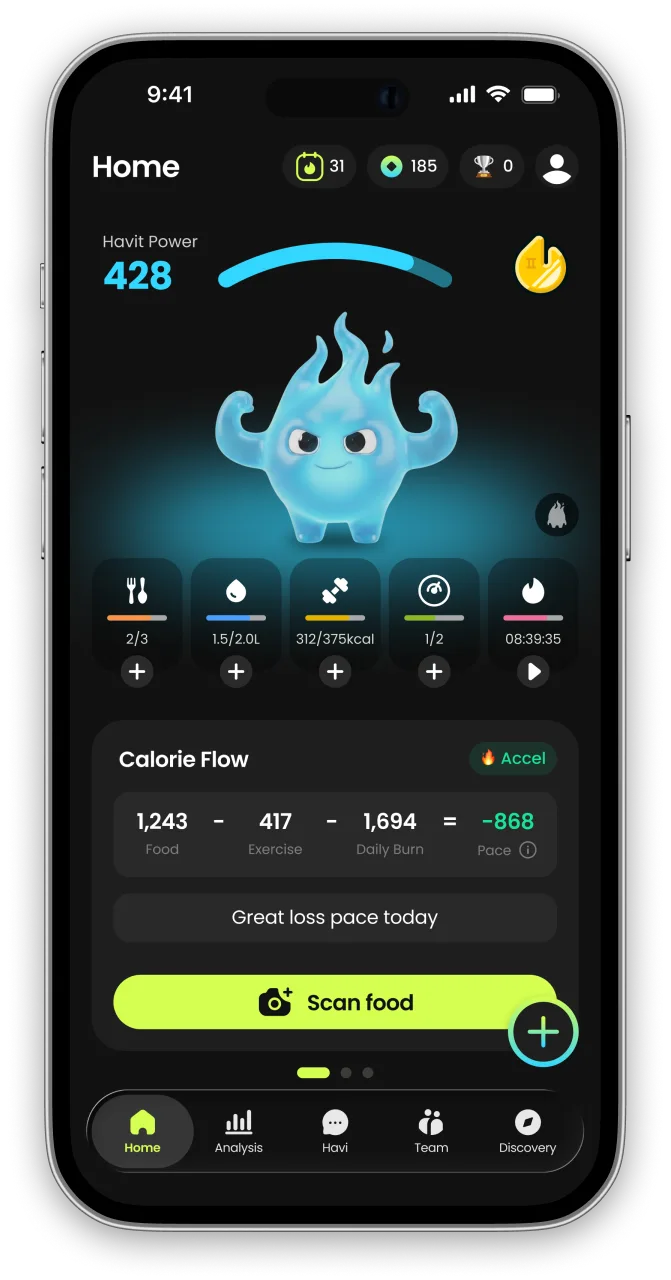
HAVIT puts the composition trend next to meals, protein, sleep, steps, cycle and medication, and the AI coach reads all of it together. So a lean-mass trend drifting down can be answered the same day: more protein, more resistance work, or a slower rate of loss.

On GLP-1 therapy, dose, side effects and protein are logged in the same app, so the lean-mass signal is never read in isolation.
The same app also carries daily missions, the daily check-in, six guided-meditation tracks, workout video, fasting and 1,400+ articles. Built with experts from Juvis Diet, a Korean diet clinic.
Stated plainly: this is rung 4. An estimate, not a measurement.
But for watching a trend and changing what you do about it, it is enough — and connecting the trend to an action is something nothing else on this list does.
Who it suits: people who want a weekly trend with no hardware, and want to know what to do about it.
04
InBody — the most widely available rung 2
| Rung | 2 (multi-frequency BIA) |
| Hardware | Dedicated device (gyms, clinics, some home units) |
| App | Result history, syncs with Samsung Health |

What it does well. Segmental readings and wide availability. Excellent for establishing a baseline.
Where it falls down. Readings move several points with hydration, food, exercise and time of day — same-day repeats can disagree. And you have to go to where the machine is, so it is not a daily-trend tool.
Who it suits: people who want a solid baseline once or twice a month.
05
Smartwatch BIA (Samsung Galaxy Watch and similar)
| Rung | 3 (hand-to-hand BIA) |
What it does well. No trip to a machine. Measure from the wrist in under a minute, and sync with other health apps.
Where it falls down. Hand-to-hand sampling under-reads the lower body, and results depend on a correct profile — Samsung's own guidance says to check your profile first if the result looks wrong.
Who it suits: people who already wear the watch.
06
Smart scales — best value for a daily trend
| Rung | 3 (foot-to-foot BIA) |
What they do well. Step on and you are done. The best value on the ladder for trend data.
Where they fall down. Foot-to-foot impedance under-samples the upper body, and readings shift with foot moisture. Do not trust the absolute number.
Who they suit: people who will stand on it at the same time every day and read only the slope.
07
Side by side
| Tool | Rung | Hardware | Daily trend | Connects to action | Read alongside |
|---|---|---|---|---|---|
| DEXA | 1 | Clinic | No | No | Nothing |
| InBody | 2 | Dedicated device | Hard | No | Nothing |
| Smartwatch BIA | 3 | Watch | Yes | No | Activity |
| Smart scale | 3 | Scale | Yes | No | Nothing |
| HAVIT | 4 | None | Yes | AI coach connects it | All 8 logs |
08
Reading your own numbers honestly
Compare like with like.
One device, one time of day, one state.
Use a four-week window.
Shorter and you are reading noise.
Watch the pair, not the percentage.
Fat mass and lean mass moving in opposite directions is the signal.
Let a real measurement anchor the trend.
An occasional InBody or DEXA, with an app filling the gaps, gets most of the value of both.
If the number distresses you, stop using it.
Weekly is plenty.
09
The bottom line
Pick the rung that matches your question. "What is my body fat percentage?" is a rung 1 or 2 question.
"Is this diet costing me muscle?" is a rung 3 or 4 question — and consumer tools answer it well enough to change what you do.
Most people need the second one. The next fork is whether anything is attached to the trend.
Frequently asked questions
What is the best app for tracking body composition?
Can an app really estimate body fat percentage?
Why does my InBody reading change between sessions?
Is Galaxy Watch body composition accurate?
Why track body composition instead of weight on Ozempic or Wegovy?
How often should I measure?
What is HAVIT?
HAVIT is an AI health partner built on metabolic science — it protects your muscle, wakes up your metabolism, and helps you keep a healthy, rebound-free body for the long run.
Unlike calorie-only trackers, HAVIT connects AI body-composition estimates, nutrition, hydration, sleep, steps, cycle, mood, and GLP-1 medication in one daily routine — so progress is measured by body composition, not just the number on the scale. Daily missions turn established behavior-change techniques into small repeatable actions, drawing on expertise from professionals formerly at Juvis Diet, one of Korea’s leading metabolic clinics.
In HAVIT’s own analysis of 1,090 GLP-1 users, people who logged consistently built stronger habits than the general user base. Read the GLP-1 Habit Report
Inside the app
- AI COACHA coach that reads your day.
- NUTRITIONLog meals in seconds.
- BODY INSIGHTSSee more than weight.
- DAILY MISSIONSBuild habits you can repeat.
- DAILY CHECK-INTell HAVI how today feels.
- TRACK EVERYTHINGFrom water to GLP-1
- MIND & RECOVERYFor the days willpower runs out.


HAVIT works with or without GLP-1 medication. It is a wellness app, not a medical device; body-composition results are estimates.
Continue in the App
Personalized wellness with your own data


References
- Misclassification of cardiometabolic health when using BMI categories (Tomiyama et al.) nature.com
- Changes in lean body mass with GLP-1-based therapies and mitigation strategies (Neeland et al.) pubmed.ncbi.nlm.nih.gov
- Weight loss to prevent obesity-related morbidity and mortality in adults: behavioral interventions — Grade B uspreventiveservicestaskforce.org
- Waist circumference as a vital sign in clinical practice (Ross et al.) nature.com
- GLP-1 Habit Report 2026 — HAVIT internal analysis of 1,090 GLP-1 users aihavit.com


