
High Blood Pressure in the Morning: Causes and Surge
Blood pressure normally falls during sleep and rises around waking. A morning surge in sympathetic nervous activity contributes, and a once-daily morning pill may be at its weakest at that time. Morning home readings are not always higher than evening ones: in one 7-day home study they averaged 142 mmHg versus 144 mmHg in the evening. In one long-term study of Black adults, a high post-waking level, not the size of the surge, was linked to cardiovascular risk. Measure within 1 hour of waking, seated, before breakfast and medication, and average several days.
This article is for general informational purposes only and is not a substitute for professional medical advice, diagnosis, or treatment. Always consult a qualified healthcare provider with questions about a medical condition.
Is blood pressure higher in the morning?
Often, yes, at least for a few hours. Blood pressure follows a 24-hour rhythm. It reaches its lowest point during sleep and climbs again around the time you wake up. Researchers call this climb the morning surge. It gets close attention because cardiovascular events such as heart attacks and strokes occur most frequently in the morning.
That does not mean every morning reading beats every evening reading. In one study, 567 adults measured their blood pressure at home twice a day for 7 days. Their average morning systolic pressure was slightly lower than their evening systolic pressure: 142 versus 144 mmHg, a gap of 144 - 142 = 2 mmHg.
So here is the fair answer to "is it higher in the morning or the evening?" The sharpest rise usually happens in the hours around waking, but your morning and evening averages can end up close together. To compare the two properly, see our guide to the difference between morning and evening blood pressure.
The reading most people worry about is the one taken soon after getting out of bed. It captures the surge while it is happening, plus whatever else your body is doing in those first minutes.
Why blood pressure rises after waking
Several things change at once when you move from sleep to wakefulness.
- Sympathetic activity switches on. The sympathetic nervous system is the body's "alert" system, and it surges in the morning. One review explains that this shift alters the mechanical forces acting on the arteries. In older adults with hypertension, the same authors found that a bigger morning surge was driven at least partly by exaggerated alpha-sympathetic activity.
- Standing up can add its own push. Some people have orthostatic hypertension, meaning their pressure rises when they stand. In hypertensive patients it has been linked to increased sympathetic activity and to a larger morning surge.
- Blood clots more easily. This does not change the number on your monitor, but it explains why morning pressure matters. Circadian changes in clotting and clot-dissolving factors make blood more prone to forming clots in the morning, while sympathetic activity and pressure are climbing.
- Medication may be at its weakest. Many blood pressure drugs are taken once a day in the morning. For these, the lowest drug level in the blood often falls during the early-morning rise in pressure and heart rate, and so does the weakest effect.
Two patterns: a sharp jump or a slow climb
Not everyone's morning rise looks the same. An older study fitted 68 untreated people with hypertension with a 24-hour blood pressure monitor and an activity tracker. It defined a morning surge as a rise of more than 50 mmHg between 4:00 and 9:00 am, compared with the lowest pressure at night. That cutoff was the 90th percentile in a group of 35 people with normal blood pressure.
Forty-one of the 68 patients met the definition. They split into two groups:
- Steep rise after waking (27 patients). Pressure jumped once they got up. This group was older, with a mean age of 72. Their systolic pressure more often tracked their physical activity, and the authors linked the pattern to an amplified arousal response.
- Gradual rise during sleep (14 patients). Pressure started climbing before waking. This group was younger, with a mean age of 62, and reached its lowest night-time value earlier.
In other words, for some people the rise is tied closely to getting out of bed, while for others it begins before they wake.
How the morning surge is measured
There is no single agreed formula. A systematic review of 17 prospective studies found seven different definitions. The three you will see most often are:
- Sleep-trough surge: average systolic pressure in the 2 hours after waking, minus the lowest systolic pressure during sleep.
- Prewaking surge: average pressure in the 2 hours after waking, minus average pressure in the 2 hours before waking. This was the most common definition in the review, used in 6 studies.
- Rising surge: the first systolic reading after waking, minus the last reading before waking.
Each formula needs readings taken while you sleep. In practice, that means wearing a 24-hour ambulatory monitor, so a home cuff cannot calculate your surge.
A home cuff can show how high your pressure is in the morning. In one study described below, that level was linked to cardiovascular risk while the surge itself was not.
Does a big morning surge raise risk?
The evidence is mixed, and the details matter.
One prospective study followed older adults with hypertension. A bigger sleep-trough surge was linked to silent damage in the blood vessels of the brain and to later stroke. Each 10 mmHg increase in the systolic surge raised stroke risk by 22%. This held after accounting for age and 24-hour blood pressure.
A meta-analysis then pooled the prospective studies. When surges were judged against fixed cutoffs, it found no clear link with cardiovascular events or stroke. Those cutoffs were prewaking surges above thresholds that ranged from 25 to 55 mmHg across studies.
The picture changed when the surge was treated as a continuous measure, which has more statistical power. Every extra 10 mmHg of surge was associated with a hazard ratio of 1.11 for stroke. That works out to roughly 11% higher risk (1.11 - 1 = 0.11).
The Jackson Heart Study took a different angle. It followed 761 Black adults for a median of 14.0 years after 24-hour monitoring. After adjustment for other factors, none of the three surge measures predicted cardiovascular events. The absolute levels did. People in the highest third for average systolic pressure in the 2 hours after waking had about four times the risk of those in the lowest third (hazard ratio 4.04).
Taken together, a large surge may carry some stroke risk, especially in older people with hypertension. In the Jackson Heart Study, the morning level itself was linked to risk even though the surge was not. That is relevant to home monitoring, because the level is what a cuff measures.
What counts as high on a morning reading?
The figures below come from the Japanese Society of Hypertension. The society has prioritised early-morning hypertension for over 20 years.
- Its home-monitoring guideline: averaged home readings of 135/85 mmHg and over count as definite hypertension. Readings under 125/80 mmHg count as normal. The guideline advises averaging morning and evening readings separately.
- Its morning campaign: in 2025 the society announced a Declaration for the Eradication of Morning Hypertension. Its main measure is the Morning Blood Pressure 130 Campaign, which encourages people to check their morning pressure in everyday settings such as homes, workplaces and public kiosks. The society reported that even among hypertensive patients taking several medicines, fewer than 30% reach a morning level below 130/80 mmHg.
These thresholds apply to averages over several days, not to a single number. Morning pressure varies from day to day, and a one-off high reading is common. Our article on blood pressure variability at home explains how to read those swings.
In the 7-day home study mentioned above, at least 4.5 days of readings were needed for a reliable diagnosis of home hypertension.
How to take a morning reading you can trust
The Japanese home-monitoring guideline sets out a precise routine:
- Measure within 1 hour of waking.
- Empty your bladder first.
- Sit and rest for 1 to 2 minutes before measuring.
- Measure before taking any medication and before breakfast.
- Use a validated upper-arm cuff. The guideline advises against wrist and finger devices.
- Take an evening reading too, just before bed, seated after 1 to 2 minutes of rest.
- Record every reading with the date, time and pulse rate, including the ones you would rather ignore. A device with memory helps avoid picking and choosing.
You do not need to measure for weeks to get a useful picture. The 7-day study found that twice-daily measurements on 3 consecutive days gave a reliable estimate of a person's usual home pressure.
A phone or a cuff with built-in memory makes it easy to keep morning and evening logs apart. The guideline asks for them to be averaged separately.
Should blood pressure medicine be taken at bedtime instead?
Morning-dosed drugs can be at their weakest during the morning rise, which has prompted interest in timing doses to match the body's daily rhythm. Researchers have tested moving doses to bedtime, but the trials are limited and the results so far do not support switching everyone.
- The International Society of Hypertension reviewed eight outcome studies of bedtime dosing. All of them had major methodological flaws and/or a high risk of bias. The society's position paper says bedtime dosing should not be routinely recommended. It favours complete 24-hour control with long-acting drugs, alone or in combination, taken as a single morning dose.
- A recent meta-analysis combined five randomised trials with 36,477 patients. It found no significant difference between bedtime and morning dosing for major cardiovascular events, death, heart attack, stroke or heart failure. The authors concluded that once-daily drugs can be taken at a time that fits the patient's routine, and that adherence matters most.
For most people, taking prescribed medicine consistently matters more than the hour on the clock. Whether to change the timing of a dose is a decision for the prescriber.
📊 Key Stats
Ways to measure morning blood pressure and what studies found
| Measure | How it is calculated | What studies found |
|---|---|---|
| Sleep-trough surge | Average systolic BP in the 2 hours after waking minus the lowest systolic BP during sleep | Older hypertensive patients: each 10 mmHg higher surge meant 22% higher stroke risk. Jackson Heart Study: not linked to CVD after adjustment |
| Prewaking surge | Average BP in the 2 hours after waking minus average BP in the 2 hours before waking | Fixed cutoffs of 25 to 55 mmHg: no clear link with events. As a continuous measure: stroke HR 1.11 per 10 mmHg |
| Rising surge | First systolic reading after waking minus last reading before waking | Jackson Heart Study: not linked to CVD after adjustment |
| Early-morning window rise | Rise of more than 50 mmHg between 4:00 and 9:00 am vs the lowest night-time BP | Seen in 41 of 68 untreated hypertensive patients, in two patterns (steep after waking, or gradual during sleep) |
| Absolute post-waking level | Average systolic BP in the 2 hours after waking | Highest vs lowest third: CVD hazard ratio 4.04 over a median 14.0 years |
| Home morning reading | Seated, within 1 hour of waking, before medication and breakfast, averaged over days | Guideline averages: 135/85 mmHg and over is definite hypertension. Among patients on several medicines, fewer than 30% reach a morning level below 130/80 mmHg |
❓ Frequently Asked Questions
Why is my blood pressure high in the morning?
Is blood pressure higher in the morning or in the evening?
At what time of day is blood pressure highest?
What is a normal blood pressure reading after waking up?
Why is my blood pressure higher right after I get out of bed?
Should I also check my blood pressure in the evening?
An AI weight-loss coach built by experts from Juvis Diet, one of Korea's leading weight-loss clinics
Analyze. Set targets in numbers. Coach every day.
Articles give everyone the same averages. HAVIT assesses your body first, uses the results to set daily targets in numbers, and works through them with you for 12 weeks.
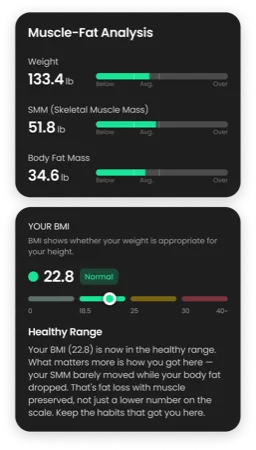
- Step 1AI body composition check, no equipment needed
Just your height, weight, age, and a few lifestyle questions are enough to estimate your body composition. In our own study (70 people), estimates were 92.9% accurate compared with InBody measurements.
- HAVIT Score and basal metabolic rate
- Muscle-fat analysis and body composition type
- Obesity level, abdominal fat ratio, and visceral fat
- Body blueprint: healthy goal weight, waist-to-height ratio, and safe rate of weight loss
- 6-stage habit analysis
- Step 211 daily targets, set in numbers
Your results set exact numbers for what to hit each day. Targets are readjusted every week based on how your weight changes.
- Calorie intake, protein, carbs, fat, and fiber
- Calories burned and steps
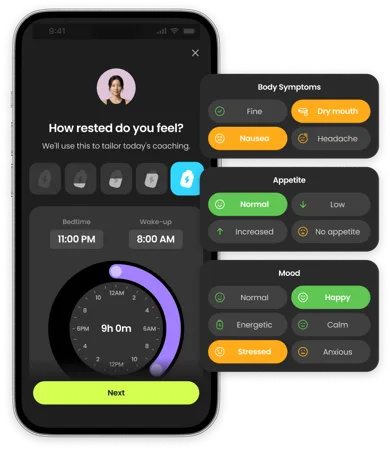
- Sleep and water
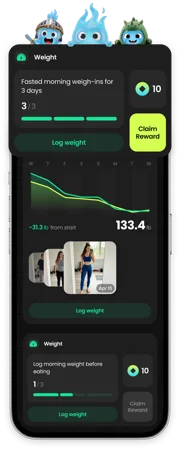
- Weigh-in frequency and target BMI
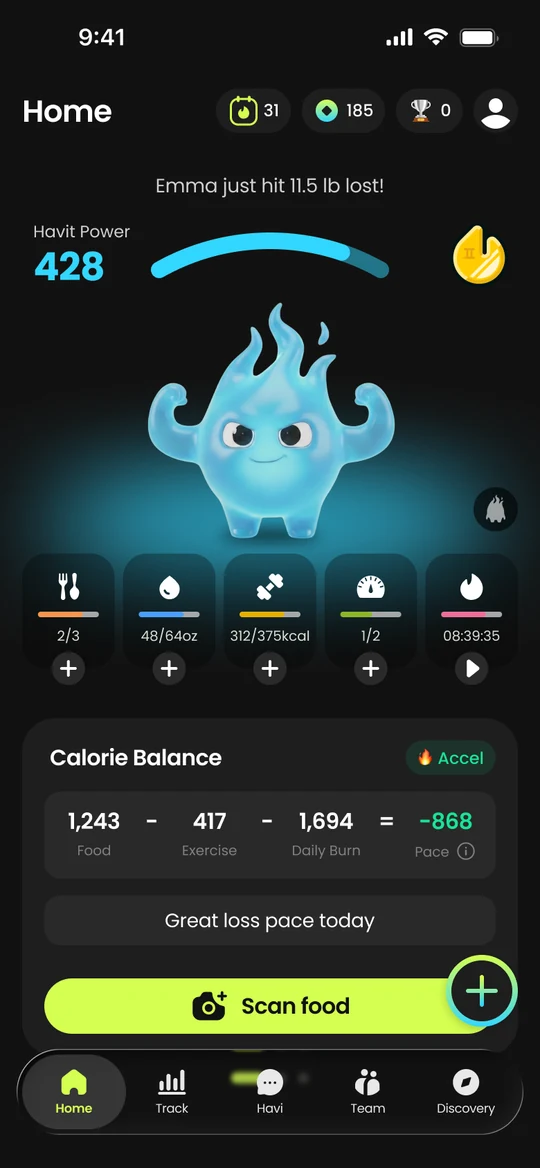
- Step 3Daily action and AI coaching
A plan only works if you follow it. We make logging easy and your next step clear.
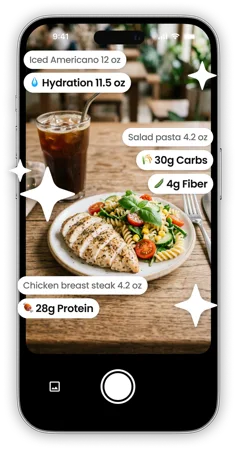
- Log meals with a single photo
- AI coach HAVI reads your logs and suggests one thing to do today
- Personalized plans across 126+ categories based on your results
- CBT-based coaching for your mindset, not just your diet

- All-in-oneEverything in one app
No more switching between apps. When everything about your body lives in one place, your AI coach can see the full picture.
- Meals, water, workouts, and steps
- Sleep, weight, and body composition trends
- Menstrual cycle, mood, and daily check-ins
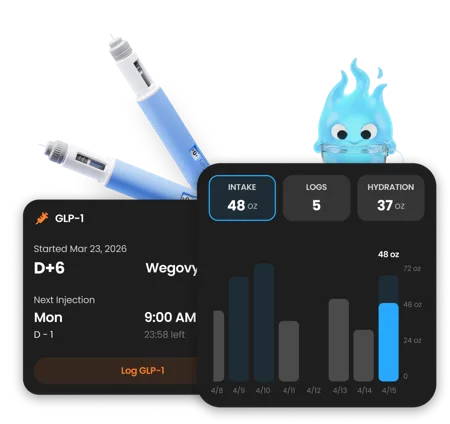
- GLP-1 medication logs and reminders
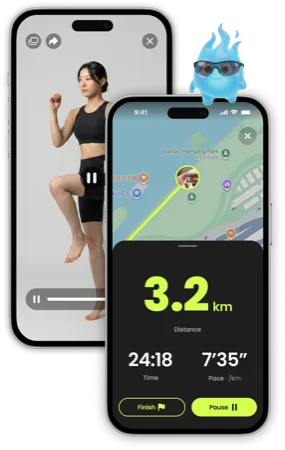
- Guided meditation, workout videos, and running coach
- Challenges and avatars that make it feel like a game
Analysis of 78 people (41 HAVIT, 37 control) with InBody results at week 1 and week 12, June–August 2026. Non-blinded study.
HAVIT is a wellness app, not a medical device. Body composition results are estimates.
A new quiz and health tip every day
Follow HAVIT on Instagram and Threads. @havit_app.en
References
- Clinical implication of morning blood pressure surge in hypertension. — Journal of cardiovascular pharmacology, 2003
- Prognostic significance of the morning blood pressure surge in clinical practice: a systematic review. — American journal of hypertension, 2015
- Morning Blood Pressure Surge and Cardiovascular Disease Events and All-Cause Mortality in Blacks: The Jackson Heart Study. — Hypertension, 2020
- Early morning surge in blood pressure. — Blood pressure monitoring, 2001
- [The relation between blood pressure variation and daily physical activity in early morning surge in blood pressure]. — Nihon Ronen Igakkai zasshi. Japanese journal of geriatrics, 1993
- Number of measurement days needed for obtaining a reliable estimate of home blood pressure and hypertension status. — Blood pressure, 2022
- Japanese society of hypertension (JSH) guidelines for self-monitoring of blood pressure at home. — Hypertension research, 2003
- The JSH Morning Hypertension Eradication Program Project. — Hypertension research, 2025
- Bedtime dosing of antihypertensive medications: systematic review and consensus statement: International Society of Hypertension position paper endorsed by World Hypertension League and European Society of Hypertension. — Journal of hypertension, 2022
- The Effect of Chronotherapy on Clinical Outcomes in Hypertensive Patients: A Systematic Review and Meta-Analysis Comparing Bedtime Versus Morning Dosing of Antihypertensive Drugs. — Health science reports, 2026