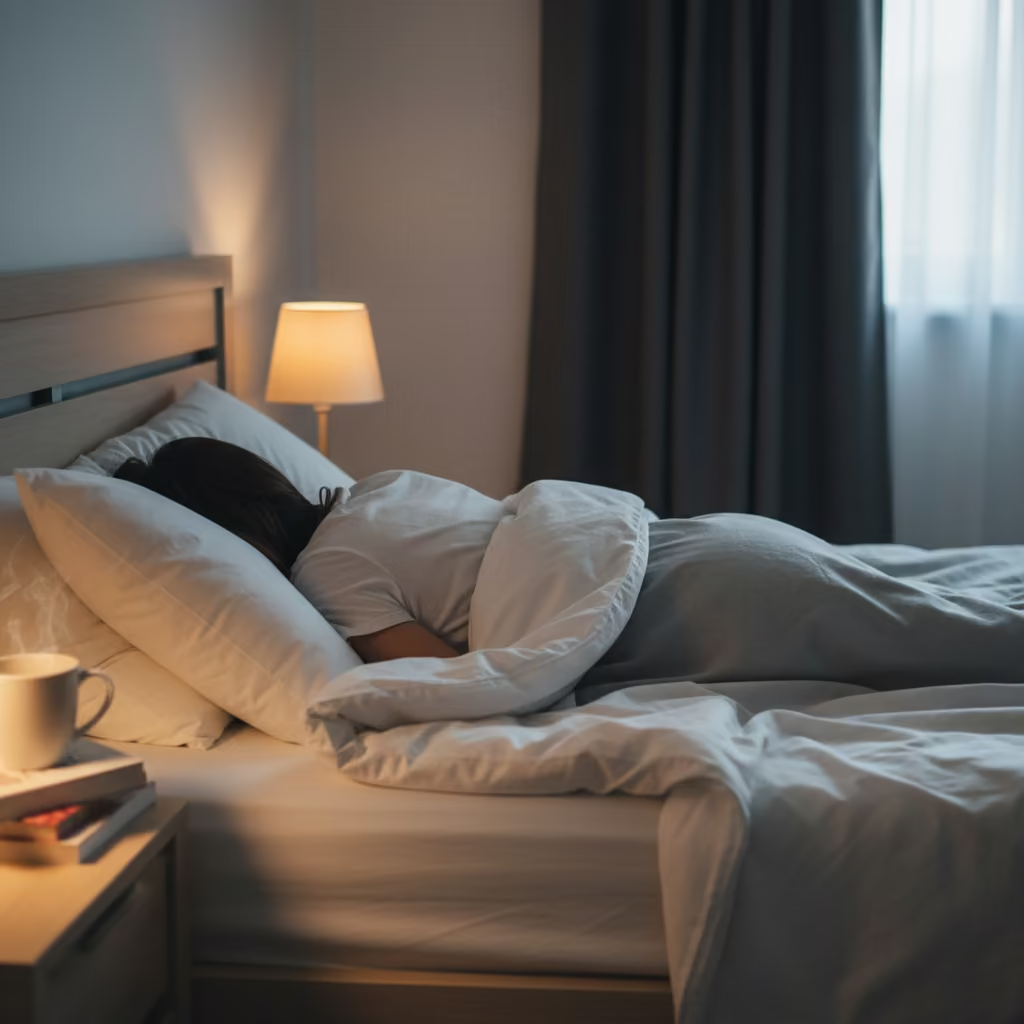

Sleeping Only 2 Hours: Better Than an All-Nighter?
If the choice is two hours of sleep or none, the research leans toward taking the two hours. Alertness worsens the longer you stay awake, and a full night without sleep impairs people more than the lost hours alone would predict. Two hours still leaves you well short of normal. Reaction time and appetite are both likely to suffer, so treat the next day as a compromised one and avoid driving if you can.
This article is for general informational purposes only and is not a substitute for professional medical advice, diagnosis, or treatment. Always consult a qualified healthcare provider with questions about a medical condition.
The short answer: two hours beats none, but not by enough
If the choice tonight is two hours of sleep or none, the evidence leans toward the two hours. This is an inference rather than a direct finding, because none of the studies below put people to bed for exactly two hours on a single night. It rests on two patterns that keep turning up in sleep-loss research.
Alertness tracks how long you have been awake. In a controlled lab study of 48 healthy adults, attention lapses climbed almost linearly once cumulative wakefulness passed about 15.84 hours, whether the sleep was lost in one go or a little at a time. Any sleep at all trims that running total.
Going entirely without sleep also hits harder than the arithmetic suggests. The same lab work found that total deprivation caused impairments disproportionately large for the amount of sleep lost, and a 2026 simulator study saw one sleepless night degrade vehicle control far more than an equal loss spread over several nights.
None of this means two hours will leave you functioning normally. Plan the next day as a compromised one, particularly if it involves time behind the wheel.
What the studies actually measured
Most people asking this question are deciding whether a short sleep is worth the bother or whether they should simply stay up. The relevant studies tested different things, and those differences limit how far each result can stretch.
- The dose-response study (Sleep, 2003) assigned 48 healthy adults to 4, 6 or 8 hours in bed per night for 14 days, or to 3 nights with no sleep. Monitoring was continuous throughout.
- The driving trial (Sleep, 2026) put 20 healthy men through three conditions: normal sleep, four nights with sleep cut by 2 hours each night, and one night without sleep. Both loss patterns added up to an equivalent 8-hour deficit. Each condition was followed by a simulated night-to-early-morning commute.
- The exercise study (Medicine and science in sports and exercise, 2020) compared a full night without sleep, a partial night equivalent to 4 hours of sleep, and normal sleep in 10 healthy active men.
In the driving trial, "2 hours" refers to sleep cut by 2 hours a night, not 2 hours of sleep. A single night with only two hours is a far deeper cut and sits much closer to an all-nighter than to mild restriction. Exactly where it lands between 4 hours and zero has never been measured directly.
Why a short sleep still counts: the wakefulness clock
The 15.84-hour threshold from the lab study gives a rough sense of what two hours buys. Over a single 24-hour stretch with no sleep, you would build up 8.16 hours of wakefulness beyond that threshold (24 − 15.84). Sleeping for 2 of those hours brings the figure down to 6.16 (22 − 15.84). Dividing the 2 hours saved by 8.16 gives roughly a quarter less of the excess wakefulness the model links to lapses.
That calculation comes from group averages collected in a lab, so it cannot forecast your own night. It does explain why even a short block of sleep is not wasted.
There is a catch. Participants' sleepiness ratings rose sharply early on and then leveled off, while their test scores kept sliding, and they were largely unaware of how impaired they had become. Feeling fine by mid-morning after a 2-hour night says little about how well you are actually performing.
What two hours won't fix: reaction time and driving
Researchers often use alcohol as a yardstick for sleepiness, which makes the risk easier to picture.
Among 39 transport and army workers, 17 to 19 hours without sleep produced performance equal to or worse than a blood alcohol concentration (BAC) of 0.05% on some tests, with response speeds up to 50% slower on certain tasks. After longer periods awake, performance sank to the level seen at the highest alcohol dose given, a BAC of 0.1%. A separate comparison of 24 hours awake against a BAC of 0.05% found that fatigue did more harm than alcohol to memory and learning and to the speed of sustained attention. Accuracy on a complex matching task suffered more as well.
In the 2026 simulator trial, drivers coming off a sleepless night lost lateral control of the car within 4 to 6 minutes, with impairments comparable to those reported at blood alcohol concentrations of 1.2 to 1.4 g/L (about 0.12% to 0.14% BAC). When the same 8-hour deficit was spread across four nights, the changes were smaller and less consistent.
A 2-hour night probably lands somewhere between those two patterns, nearer the acute one. If someone else can drive or the trip can wait, let it, and take particular care late at night or in the early morning.
Hunger, metabolism and exercise the next day
Appetite responds quickly. In a crossover study of 12 healthy young men, two days of restricted sleep, compared with extended sleep, cut leptin (the hormone that signals fullness) by 18% and raised the hunger hormone ghrelin by 28%. Hunger went up 24% and appetite 23%. The pull toward calorie-dense, high-carbohydrate foods grew most, by 33% to 45%.
Those figures come from two nights rather than one, and energy expenditure was not measured, so they show the direction of the effect better than its size. Anyone who has reached for cookies or a bagel after a bad night will recognize it.
Blood sugar control shifts as well, although the clearest data involve repeated nights. When 20 healthy men spent 7 nights at 5 hours in bed, insulin sensitivity fell by 20 ± 24% on one test and by 11 ± 5.5% on a clamp test, while salivary cortisol rose by 51 ± 8%. A single 2-hour night is a different exposure, but it likely pushes in the same direction.
Exercise is where partial and total sleep loss separate most clearly. In the cycling study of 10 active men, a sleepless night raised resting IL-6, an inflammatory signal, and lowered blood glucose. Fatigue and perceived effort went up, while free-living energy expenditure and maximal exercise performance came down. The night equivalent to 4 hours of sleep had minimal effects. Two hours sits between the two conditions, so a hard planned session will probably feel tougher and produce less.
Mood, impulses and decisions
Short sleep also changes how you feel and how you choose. Nineteen young adults were tested after restricted sleep and after their usual sleep. When restricted, they were sleepier and slower on a vigilance task, reported less positive mood and took more risks on a balloon-pumping task. Negative mood held steady, which may be why people tend to describe themselves as flat rather than upset after a short night.
If you are managing your weight, this overlaps with the hunger findings in an unhelpful way, since lower mood and looser impulse control make unplanned eating easier. Big financial or work decisions are worth postponing where you can.
Getting through the day after
A nap is the most useful tool available, though it only covers part of the gap.
In a randomized trial with anesthesia residents, a 30-minute nap opportunity after a 24-hour shift raised simulated crisis performance by 14.8 points, a 7.4% improvement over controls. The gains came in non-technical skills such as leadership and resource use, and technical skills did not differ significantly between groups.
Naps have limits. In another study, a one-hour afternoon nap after a night of total sleep deprivation did not clearly restore performance on a finger-tapping skill task, and repeated practice through the day did not restore it either. What seemed to work was recovery sleep on the following nights. It appeared to cancel out the effect of the lost night, with performance gains showing up after a one-week delay.
On the day itself, put demanding or safety-critical tasks early if they cannot wait, and keep the afternoon simple. Deciding your meals in advance gives hunger less room to steer you. Swap a maximal workout for something easy, such as a walk, and go to bed at a reasonable hour that night instead of pushing through to a late bedtime.
For a step-by-step plan, see our all-nighter recovery protocol for the next day.
When a 2-hour night becomes a pattern
One short night is usually recoverable. A string of them is another matter. In the lab study, 14 days at 4 or 6 hours a night produced cognitive deficits equivalent to up to 2 nights of total sleep deprivation, and over that stretch people's sense of sleepiness stopped matching how impaired they were.
The simulator trial found that spread-out restriction harmed driving less than one sleepless night. Because that result compares two kinds of sleep loss with each other, it offers no reassurance that repeated short nights are harmless, and the week-long insulin study shows metabolic costs building over consecutive short nights.
When shift work or caregiving makes two-hour nights routine (students in exam season know the pattern too), naps will not close the gap. Protecting longer sleep opportunities on as many nights as possible is the more reliable fix. Our guide to sleep debt and the weekend catch-up myth explains why sleeping in on weekends does not settle the account.
📊 Key Stats
How different amounts of sleep loss compare
| Scenario | Main finding | Source |
|---|---|---|
| One night without sleep (0 h) | Lane-keeping deteriorated within 4–6 min of a simulated commute, comparable to BAC 1.2–1.4 g/L (about 0.12–0.14%) | Sleep, 2026 |
| 24 h of sustained wakefulness | Impairment greater than at BAC 0.05% on attention speed and on memory and learning | Journal of sleep research, 2003 |
| 17–19 h without sleep | Some tests equal to or worse than at BAC 0.05%; response speeds up to 50% slower | Occupational and environmental medicine, 2000 |
| 2 h of sleep in a 24-h day (model illustration) | 22 − 15.84 = 6.16 h of excess wakefulness, vs 24 − 15.84 = 8.16 h with no sleep | Sleep, 2003 |
| One night equivalent to 4 h of sleep | Minimal effects; a night without sleep raised perceived effort and reduced maximal exercise performance | Medicine and science in sports and exercise, 2020 |
| Four nights with 2 h less sleep each (8-h total loss) | Smaller, less consistent driving changes than one night without sleep | Sleep, 2026 |
| 4 or 6 h per night for 14 days | Cognitive deficits equivalent to up to 2 nights of total sleep deprivation | Sleep, 2003 |
❓ Frequently Asked Questions
Is 2 hours of sleep better than no sleep at all?
Can I drive after only 2 hours of sleep?
Why am I so hungry after sleeping 2 hours?
Should I take a nap the day after a 2-hour night?
Is it OK to work out after 2 hours of sleep?
How long does it take to recover from one 2-hour night?
An AI weight-loss coach built by experts from Juvis Diet, one of Korea's leading weight-loss clinics
Analyze. Set targets in numbers. Coach every day.
Articles give everyone the same averages. HAVIT assesses your body first, uses the results to set daily targets in numbers, and works through them with you for 12 weeks.
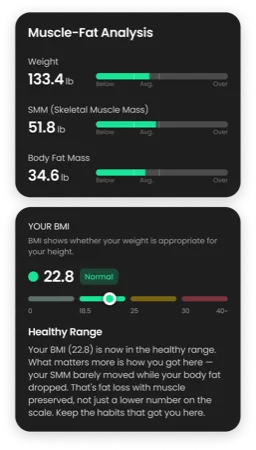
- Step 1AI body composition check, no equipment needed
Just your height, weight, age, and a few lifestyle questions are enough to estimate your body composition. In our own study (70 people), estimates were 92.9% accurate compared with InBody measurements.
- HAVIT Score and basal metabolic rate
- Muscle-fat analysis and body composition type
- Obesity level, abdominal fat ratio, and visceral fat
- Body blueprint: healthy goal weight, waist-to-height ratio, and safe rate of weight loss
- 6-stage habit analysis
- Step 211 daily targets, set in numbers
Your results set exact numbers for what to hit each day. Targets are readjusted every week based on how your weight changes.
- Calorie intake, protein, carbs, fat, and fiber
- Calories burned and steps
- Sleep and water
- Weigh-in frequency and target BMI
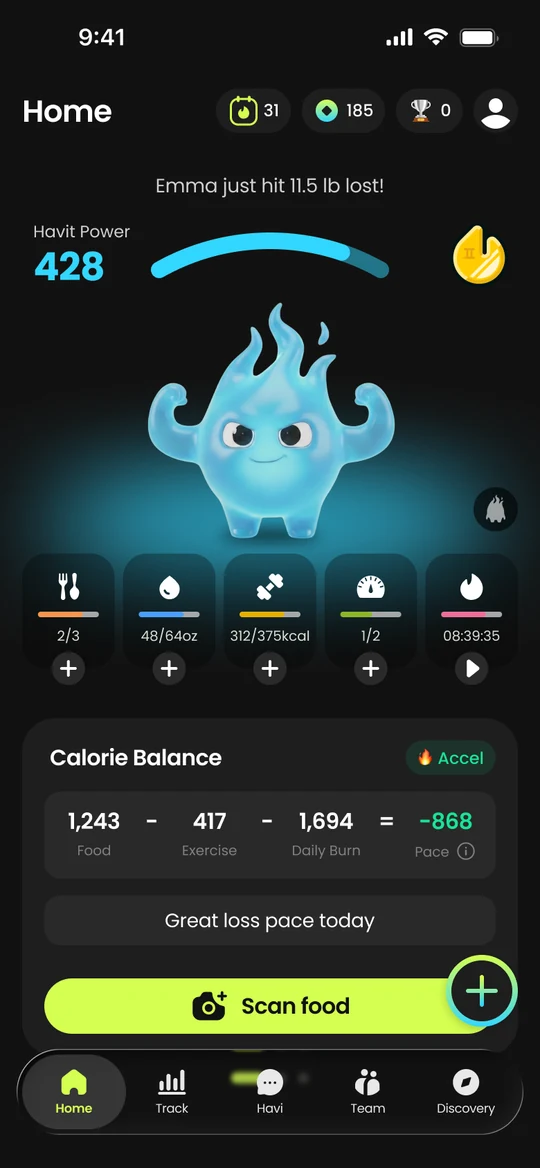
- Step 3Daily action and AI coaching
A plan only works if you follow it. We make logging easy and your next step clear.
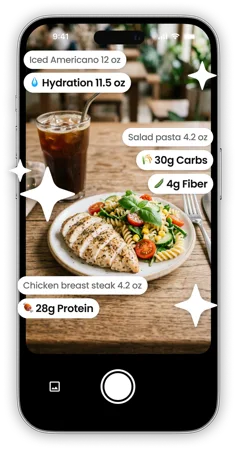
- Log meals with a single photo
- AI coach HAVI reads your logs and suggests one thing to do today
- Personalized plans across 126+ categories based on your results
- CBT-based coaching for your mindset, not just your diet

- All-in-oneEverything in one app
No more switching between apps. When everything about your body lives in one place, your AI coach can see the full picture.
- Meals, water, workouts, and steps
- Sleep, weight, and body composition trends
- Menstrual cycle, mood, and daily check-ins
- GLP-1 medication logs and reminders
- Guided meditation, workout videos, and running coach
- Challenges and avatars that make it feel like a game
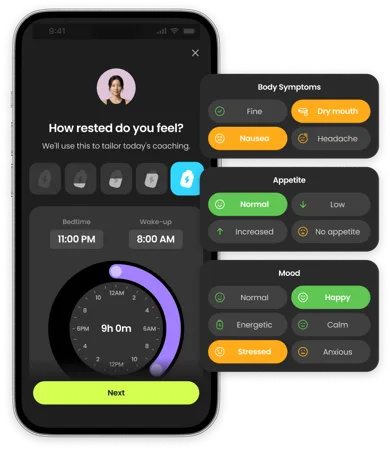
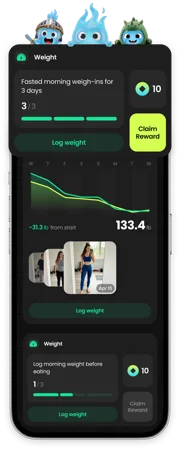
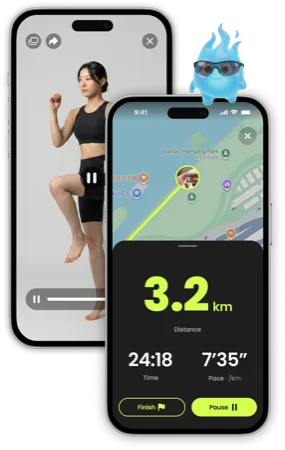
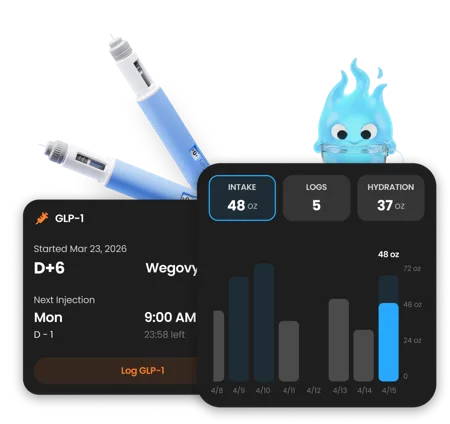
Analysis of 78 people (41 HAVIT, 37 control) with InBody results at week 1 and week 12, June–August 2026. Non-blinded study.
HAVIT is a wellness app, not a medical device. Body composition results are estimates.
A new quiz and health tip every day
Follow HAVIT on Instagram and Threads. @havit_app.en
References
- The cumulative cost of additional wakefulness: dose-response effects on neurobehavioral functions and sleep physiology from chronic sleep restriction and total sleep deprivation. — Sleep, 2003
- Moderate sleep deprivation produces impairments in cognitive and motor performance equivalent to legally prescribed levels of alcohol intoxication. — Occupational and environmental medicine, 2000
- Sleep Deprivation: Cytokine and Neuroendocrine Effects on Perception of Effort. — Medicine and science in sports and exercise, 2020
- Commonly experienced acute and cumulative 8-hour sleep loss differentially affect simulated driving during a night-time to early-morning commute: a randomized controlled crossover trial. — Sleep, 2026
- Qualitative similarities in cognitive impairment associated with 24 h of sustained wakefulness and a blood alcohol concentration of 0.05%. — Journal of sleep research, 2003
- Sleep restriction for 1 week reduces insulin sensitivity in healthy men. — Diabetes, 2010
- Clinical Performance in Critical Care Simulation under Sleep Deprivation: Effects of Power Napping in the Recovery Napping Protocol for Anesthesiologist Performance (R-NAP) Randomized Controlled Trial. — Anesthesiology, 2026
- Procedural performance following sleep deprivation remains impaired despite extended practice and an afternoon nap. — Scientific reports, 2016
- Brief communication: Sleep curtailment in healthy young men is associated with decreased leptin levels, elevated ghrelin levels, and increased hunger and appetite. — Annals of internal medicine, 2004
- The effects of sleep restriction on executive inhibitory control and affect in young adults. — The Journal of adolescent health : official publication of the Society for Adolescent Medicine, 2014