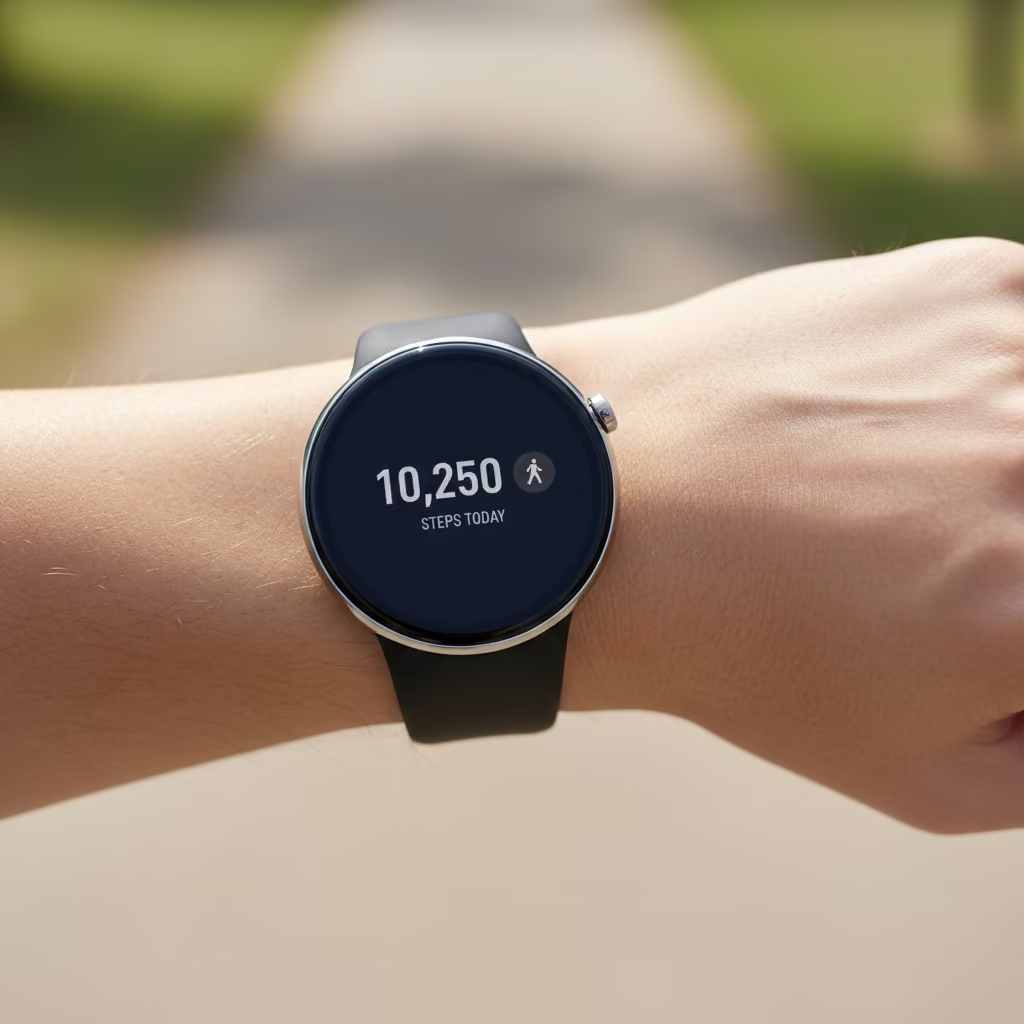

Calories Burned by Steps: What 15,000 Steps Burns
Using a guideline conversion of about 1,575 steps per km (3,150 steps per 2 km), 15,000 steps covers roughly 9.5 km (15,000 ÷ 1,575). Multiplying that distance by a field-measured walking cost of 0.96 kcal per kg per km gives about 9.1 kcal per kilogram of body weight (9.52 × 0.96 ≈ 9.14). Multiply that figure by your weight in kilograms for a personal estimate. Speed, hills, uneven ground and carried weight push the real number up or down.
This article is for general informational purposes only and is not a substitute for professional medical advice, diagnosis, or treatment. Always consult a qualified healthcare provider with questions about a medical condition.
The short answer: calories burned by 15,000 steps
Combining two published figures, walking 15,000 steps works out to roughly 9.1 kcal for every kilogram you weigh (15,000 ÷ 1,575 ≈ 9.52 km, then 9.52 × 0.96 ≈ 9.14). To get your own number, multiply 9.1 by your body weight in kilograms.
The calculation has three parts:
- Distance: 15,000 steps is about 9.5 km (15,000 ÷ 1,575 steps per km), using a step-to-distance conversion from a walking recommendation.
- Energy per distance: walking outdoors cost about 0.96 kcal per kilogram per kilometre.
- Result: 9.52 km × 0.96 ≈ 9.14 kcal per kg.
The number is a sensible starting estimate, not a precise reading. The rest of this guide shows where it comes from, how to adjust it for your own stride and routes, and why your watch may show something quite different.
Where the per-step numbers come from
Two things determine calories burned by steps: how far each step carries you, and how much energy each kilometre of walking costs your body.
Energy per kilometre
A field study measured habitual commuting pedestrians (10 men and 10 women, middle-aged) during their real walk to work around Greater Stockholm, rather than on a treadmill. Their energy expenditure amounted to 0.96 kcal · kg⁻¹ · km⁻¹. Men and women had similar absolute energy demands for a given distance.
These commuters walked briskly, at average speeds of 5.7 km/h for men and 5.9 km/h for women. That pace corresponded to about 46% of maximal oxygen uptake and MET values of 6.2 and 6.5. The researchers place this in the lower part of the moderate relative intensity range.
Steps per kilometre
A cross-sectional study of 226 Chinese young adults with a mean age of 21.7 measured walking over ground. It translated activity guidelines into walking targets: 30 minutes at 105 steps per minute, which equals 3,150 steps or 2 km.
Dividing gives a working ratio: 3,150 ÷ 2 = 1,575 steps per km, or an average step length of about 0.63 m (1,000 m ÷ 1,575). This ratio is a conversion built into a walking recommendation, not a direct measurement of anyone's stride, so treat it as a default to replace with your own figure.
Your own ratio may differ. The same study found that, at the same walking speed, women took more steps per minute than men. Shorter steps mean more steps per kilometre.
How to calculate calories for any step count
The method works for any step total.
- Convert steps to distance: km = steps ÷ 1,575 (or use your own steps-per-km figure).
- Convert distance to energy: kcal = km × 0.96 × body weight in kg.
Put together, the shortcut is kcal ≈ steps × 0.00061 × body weight (kg), because 0.96 ÷ 1,575 ≈ 0.00061.
A few reference points:
- 1,000 steps: 0.635 km × 0.96 ≈ 0.61 kcal per kg
- 10,000 steps: 6.35 km × 0.96 ≈ 6.1 kcal per kg
- 15,000 steps: 9.52 km × 0.96 ≈ 9.1 kcal per kg
Personalise the stride figure
The biggest easy improvement is replacing 1,575 with your own number. Walk a route of known length at your normal pace and note the step count. Divide steps by kilometres. If you take fewer steps per kilometre than 1,575, the same step count covers more distance, so the formula gives a higher estimate. If you take more steps per kilometre, it gives a lower one.
Because the energy figure is expressed per kilogram, the estimate scales directly with body weight in the formula.
Why your real number may be higher or lower
The 0.96 figure describes brisk commuting on city routes. Several factors shift it.
Speed
A study combining experiments with a minimal walking model found that the energy cost of walking per distance is highly sensitive to speed. For running, the cost per distance stays nearly constant across speeds. For walking it does not, so a slow amble and a fast stride over the same 15,000 steps will not cost the same.
Uneven ground
A study of 10 healthy adults walking on synthetic uneven terrain at four speeds between 0.8 and 1.4 m/s found that net metabolic rate rose roughly with the square of terrain bumpiness and with speed cubed. Trails, cobbles and broken pavement all add cost compared with smooth ground.
Treadmill versus outdoors
In the Stockholm commuter study, walking in the field demanded about 30% more energy per km than level treadmill walking. The study's summary does not give a separate treadmill value, so treat 0.96 as an outdoor figure and expect a level treadmill walk of the same length to come in lower.
Load, hills and body mass
A review of soldier load carriage found that the energy cost of walking with backpack loads rises with the weight carried, body mass, walking speed and grade. Terrain type also matters. Where the load sits matters too: each kilogram added to the foot increased energy expenditure by 7% to 10%, compared with 4% per kilogram on the thigh. Heavy shoes, a loaded backpack or a hilly route all raise the per-step cost.
Total versus active calories
The study reports 0.96 kcal per kg per km as energy expenditure during walking, without stating in its summary whether resting energy was subtracted. Keep that in mind when comparing the formula with a device readout. If your screen shows more than one calorie number for the same walk, this explainer on active versus total calories covers the difference.
How long 15,000 steps takes, and how hard it is
Time depends on cadence, the number of steps per minute.
- At 100 steps per minute: 15,000 ÷ 100 = 150 minutes
- At 105 steps per minute: 15,000 ÷ 105 ≈ 143 minutes
So 15,000 steps is roughly two and a half hours of walking, whether in one block or across a day.
Cadence also gives a rough idea of intensity. A study of pregnant women notes that 100 steps per minute is the established marker of the moderate-intensity threshold of 3 METs in non-pregnant people. The study found the 3 MET cut-off held in pregnancy too. In the Chinese young adults study, the cut-points were 105 steps per minute for 3 METs and 130 steps per minute for 6 METs.
In practice, steps taken at a brisk, purposeful pace cost more per minute than slow pottering steps. Brisk walking also fits more distance, and more calories, into the same amount of time.
What your watch or phone reports
It is tempting to read the calorie number straight off a wearable. The research suggests caution.
- A systematic review of 65 articles on wrist-worn trackers found that, for energy expenditure, the mean absolute percentage error was above 30% for all brands. The review concluded that none of the tested devices measured energy expenditure accurately.
- A lab study tested seven wrist-worn devices against indirect calorimetry in 60 volunteers. No device achieved an energy expenditure error below 20 percent. Errors were highest for walking.
Step counts hold up better. The same review found that the Fitbit Charge models showed good accuracy for step counts. A reasonable approach is to trust the step count more than the calorie figure. If you want a second estimate, run the steps through the distance-and-weight formula above. The wearable calorie accuracy guide goes into why the calorie estimates drift.
Is 15,000 steps worth it beyond calories?
Calories are only part of the story. Several large meta-analyses link daily steps with health outcomes, and 15,000 steps sits above the ranges where most of the measured benefit appears.
- A meta-analysis of 15 international cohorts (47,471 adults) found progressively lower mortality risk with more steps. The risk levelled off at around 6,000–8,000 steps per day in adults aged 60 and older, and 8,000–10,000 in those younger than 60.
- A dose-response meta-analysis found that, compared with 2,000 steps per day, 7,000 steps per day was associated with a 47% lower risk of all-cause mortality.
These are observational associations, and the curves flatten at higher counts. Going from 10,000 to 15,000 steps is a reasonable way to raise energy expenditure. The data do not suggest it is necessary for the mortality benefits seen at more moderate counts. For background on where the popular target came from, see the origin of the 10,000-steps goal.
Using step calories for weight management
A few practical points follow from the evidence.
Use the estimate as a range, not a ledger. Speed, terrain, load and stride all move the true figure. Treat 9.1 kcal per kg for 15,000 steps as a midpoint for brisk outdoor walking. Expect less on a flat treadmill and more on hilly or rough routes.
Walking volume adds up over time. In the Stockholm study, regular walking commutes produced a total weekly energy expenditure of about 1,570 kcal for men and 1,040 kcal for women. Over the year, participants made about 385 trips covering about 800 km. Steady, repeated walking can account for a meaningful share of weekly energy use.
Build up gradually. Jumping from a low daily count to 15,000 steps adds a lot of time on your feet. Raising the count in steps lets you notice how your appetite, energy and joints respond.
Do not let the calorie number drive eating decisions on its own. Wrist-worn calorie estimates carry large errors. Watching trends in weight and waist measurements over weeks gives a more reliable signal than a single day's readout.
The simplest summary: count your steps with a device, convert them to distance using your own stride, and multiply by 0.96 and your body weight. That gives a reasonable estimate of calories burned by steps that you can check against your own results.
📊 Key Stats
Estimated calories burned by steps (brisk outdoor walking)
| Daily steps | Approx. distance (steps ÷ 1,575) | kcal per kg body weight (km × 0.96) | Context |
|---|---|---|---|
| 3,150 | 2.0 km | 1.92 | 30 minutes at 105 steps/min |
| 6,000 | 3.81 km | 3.66 | Daily transport-steps recommendation from a commuter study |
| 7,000 | 4.44 km | 4.27 | Linked with 47% lower all-cause mortality vs 2,000 steps/day |
| 10,000 | 6.35 km | 6.10 | The widely promoted daily target |
| 15,000 | 9.52 km | 9.14 | About 143 minutes at 105 steps/min |
❓ Frequently Asked Questions
How many calories do 15,000 steps burn?
How many calories does one step burn?
How far is 15,000 steps?
How long does it take to walk 15,000 steps?
Are smartwatch calorie counts for walking accurate?
Do I burn more calories walking outside than on a treadmill?
An AI weight-loss coach built by experts from Juvis Diet, one of Korea's leading weight-loss clinics
Analyze. Set targets in numbers. Coach every day.
Articles give everyone the same averages. HAVIT assesses your body first, uses the results to set daily targets in numbers, and works through them with you for 12 weeks.
- Step 1AI body composition check, no equipment needed
Just your height, weight, age, and a few lifestyle questions are enough to estimate your body composition. In our own study (70 people), estimates were 92.9% accurate compared with InBody measurements.
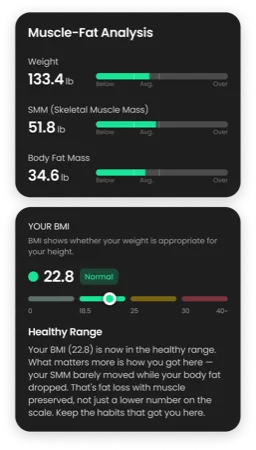
- HAVIT Score and basal metabolic rate
- Muscle-fat analysis and body composition type
- Obesity level, abdominal fat ratio, and visceral fat
- Body blueprint: healthy goal weight, waist-to-height ratio, and safe rate of weight loss
- 6-stage habit analysis
- Step 211 daily targets, set in numbers
Your results set exact numbers for what to hit each day. Targets are readjusted every week based on how your weight changes.
- Calorie intake, protein, carbs, fat, and fiber
- Calories burned and steps
- Sleep and water
- Weigh-in frequency and target BMI
- Step 3Daily action and AI coaching
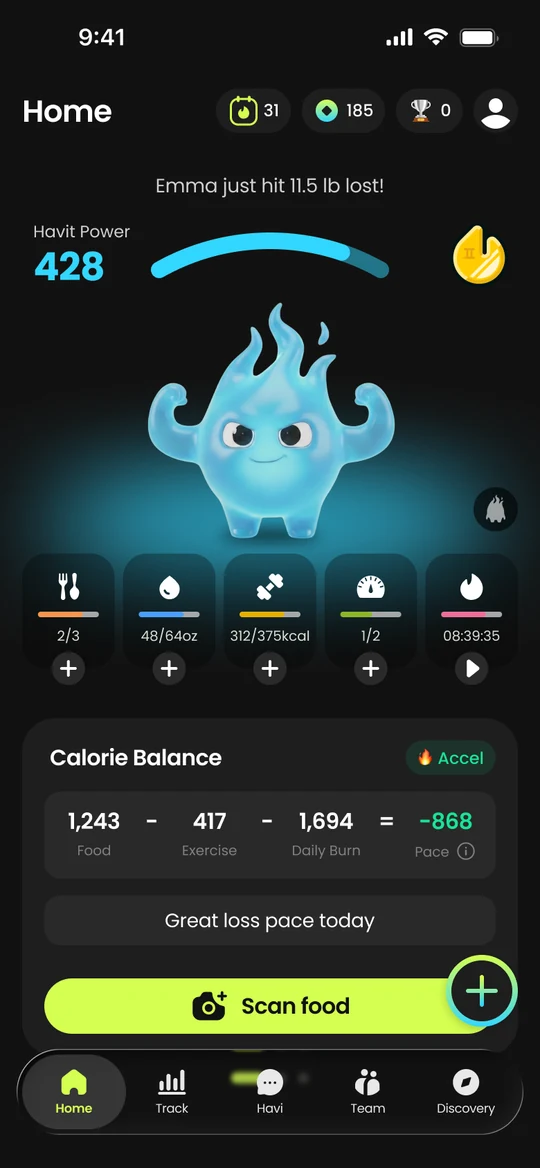
A plan only works if you follow it. We make logging easy and your next step clear.
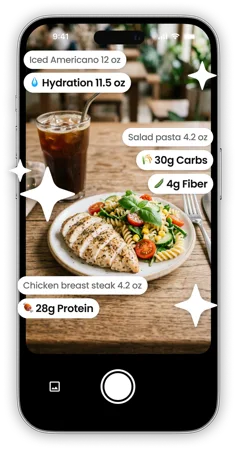
- Log meals with a single photo
- AI coach HAVI reads your logs and suggests one thing to do today
- Personalized plans across 126+ categories based on your results
- CBT-based coaching for your mindset, not just your diet

- All-in-oneEverything in one app
No more switching between apps. When everything about your body lives in one place, your AI coach can see the full picture.
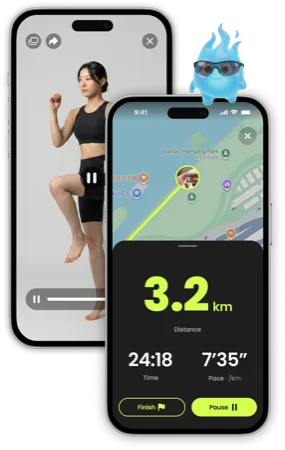
- Meals, water, workouts, and steps
- Sleep, weight, and body composition trends
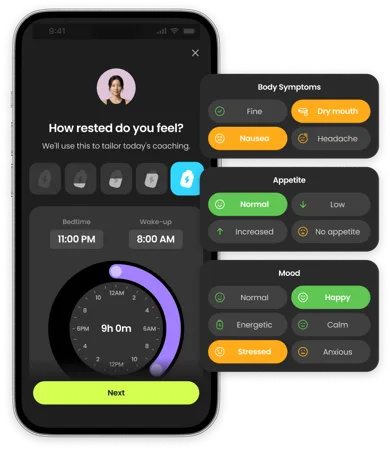
- Menstrual cycle, mood, and daily check-ins
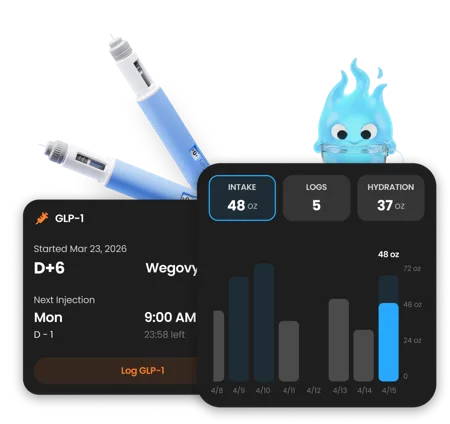
- GLP-1 medication logs and reminders
- Guided meditation, workout videos, and running coach
- Challenges and avatars that make it feel like a game

Analysis of 78 people (41 HAVIT, 37 control) with InBody results at week 1 and week 12, June–August 2026. Non-blinded study.
HAVIT is a wellness app, not a medical device. Body composition results are estimates.
A new quiz and health tip every day
Follow HAVIT on Instagram and Threads. @havit_app.en
References
- Perspectives on exercise intensity, volume, step characteristics and health outcomes in walking for transport. — Frontiers in public health, 2022
- Step rate-determined walking intensity and walking recommendation in Chinese young adults: a cross-sectional study. — BMJ open, 2013
- The energy cost of walking is sensitive to speed but not gravity; for running, it's the other way around: model and experiment. — The Journal of experimental biology, 2026
- The energetic cost of human walking as a function of uneven terrain amplitude. — The Journal of experimental biology, 2025
- Soldier load carriage: historical, physiological, biomechanical, and medical aspects. — Military medicine, 2004
- Walking Cadence during Moderate-Intensity Physical Activity in Pregnant Women. — International journal of environmental research and public health, 2021
- Accuracy and Acceptability of Wrist-Wearable Activity-Tracking Devices: Systematic Review of the Literature. — Journal of medical Internet research, 2022
- Accuracy in Wrist-Worn, Sensor-Based Measurements of Heart Rate and Energy Expenditure in a Diverse Cohort. — Journal of personalized medicine, 2017
- Daily steps and all-cause mortality: a meta-analysis of 15 international cohorts. — The Lancet. Public health, 2022
- Daily steps and health outcomes in adults: a systematic review and dose-response meta-analysis. — The Lancet. Public health, 2025