
GLP-1 Progress Tracker: See Results Beyond the Scale

Este artículo tiene fines informativos generales y no sustituye el consejo, diagnóstico o tratamiento médico profesional. Consulte siempre a un profesional sanitario cualificado.
Respuesta rápida
A GLP-1 progress tracker follows your weight trend, body composition, measurements, photos and non-scale victories — so you see real progress even when the scale stalls.
On a GLP-1 like Wegovy, Ozempic, Zepbound or Mounjaro, "progress" is bigger than a single number.
Weight comes off in a jagged, non-linear way; body composition shifts underneath a flat scale; and some of your biggest wins — looser clothes, steadier energy, better bloodwork — never show up as pounds at all.
A progress tracker exists to capture that whole picture, so a stubborn scale week never convinces you your plan has stopped working.
This page is about seeing progress across every dimension.
For the mechanics of the scale itself — how to weigh, read a trend, and measure body composition — start with our weight loss tracker for GLP-1.
And for how progress logging fits alongside dose, injection and side-effect tracking, see the GLP-1 tracker app hub.
01
Why the scale is only one progress signal
The scale answers one question — are you lighter? — and answers it badly day to day.
Body weight can swing two to four pounds from water, sodium, carbohydrate, digestion, and hormones, so a single reading tells you almost nothing about whether the last two weeks worked.
Worse, the scale is blind to what you are losing.
Across GLP-1 trials the lean-mass share of total weight lost has varied widely — 40–60% in some studies, 15% or less in others — and lean mass includes organs, bone and fluid as well as muscle (Neeland et al., Diabetes, Obesity and Metabolism, 2024).
A weight-only view can show "success" while you quietly lose the tissue that protects your metabolism.
Real progress is fat down, muscle held, and health markers improving — and that needs more than one number.
02
The GLP-1 progress picture: what to track
Layer your signals by how fast they move.
Fast numbers get read as trends; slow, meaningful changes get measured less often; and the wins that never hit the scale get noticed on purpose.
You do not need every row. A workable minimum is a weekly weight trend, monthly waist and photos, one strength marker, and a running note of non-scale victories.
Add a body-composition check every one to three months if you have a smart scale, BIA device, or DEXA scan.
| Progress signal | How often | What progress looks like |
|---|---|---|
| Weight trend (not daily number) | Weekly | A falling 4-week moving line, even with up days |
| Waist circumference | Monthly | Fewer centimetres; a lower waist-to-height ratio |
| Body measurements (hips, thigh, arm) | Monthly | Size dropping where the scale can't localise |
| Progress photos (front/side/back) | Every 2–4 weeks | Visible shape change, especially at plateaus |
| Body composition (fat % / lean mass) | Every 4–12 weeks | Fat mass down, lean mass holding steady |
| Strength marker (reps or load) | Weekly / biweekly | Same or more strength = muscle is protected |
| Non-scale victories (energy, clothes, sleep, labs) | As they happen | Real-life wins the scale never records |

03
Body composition: is the loss fat, not muscle?
Because lean mass can be such a large share of GLP-1 weight loss, body composition is the single most valuable "beyond the scale" progress metric.
Home smart scales and handheld bioelectrical-impedance (BIA) devices give rough, trend-friendly estimates; a DEXA scan is the gold-standard baseline if you want precise numbers.
What matters is the direction over months: fat mass falling while lean mass holds is the highest-quality progress there is, and it is exactly what protein and resistance training are meant to protect (American Diabetes Association).
If lean mass is dropping fast, treat that as a signal to raise protein and add strength work — see the protein tracker for GLP-1.
Waist circumference is the cheapest body-composition proxy you have.
Keeping your waist under half your height — a waist-to-height ratio below 0.5 — is a simple central-adiposity target used in clinical guidance, and watching that ratio fall is progress even on a flat-scale week (NICE).
04
Non-scale victories: progress the scale can't show
Some of the most durable progress on a GLP-1 never appears in pounds. Track these deliberately, because they carry you through plateaus:
- Clothes fit differently — a belt notch, a size down, rings looser.
- Steadier energy and fewer cravings as appetite signalling changes.
- Better sleep and mood, and less "food noise."
- Improving health markers your clinician measures — blood pressure, A1C, cholesterol, resting heart rate.
- Strength and stamina — more reps, easier stairs, longer walks.
- Habit streaks — protein targets hit, movement days, hydration.
Logging non-scale victories is not fluff.
When the scale stalls for a fortnight, a written record of what improved anyway is often the difference between staying the course and quitting a plan that is actually working.

05
Reading a plateau as progress, not failure
Plateaus are normal on GLP-1 therapy, and in the STEP-1 trial semaglutide's average weight loss continued for well over a year before levelling off around 15% (NEJM STEP-1); tirzepatide reached roughly 20–22% in SURMOUNT-1 (NEJM SURMOUNT-1).
A multi-signal tracker lets you tell a true plateau (trend flat, measurements flat, photos unchanged over 3–4 weeks) from mere scale noise (one high reading in an otherwise falling trend).
And a genuine plateau is often invisible progress: if your waist is still shrinking and your strength marker is up while weight holds, you are trading fat for muscle — the outcome you actually want.
Bring persistent, multi-week plateaus to your prescriber before changing anything.
06
How to run a weekly progress check
You do not need a complicated system — you need a repeatable one. Here is a five-minute weekly review:
- 1
Log your weight as a trend.
Weigh under the same conditions and read the 4-week moving line, not the single number.
- 2
Update measurements monthly.
Waist at the navel plus hips, thigh, and arm — same landmarks, same time of day.
- 3
Take progress photos every 2–4 weeks.
Same lighting, clothing, and pose so the comparison is honest.
- 4
Check body composition every 1–3 months.
Smart scale, BIA, or DEXA — watch fat down and lean held.
- 5
Log at least one non-scale victory.
Energy, sleep, clothes, a lab number, a strength PR — write it down.
- 6
Review the whole picture, not one row.
Before each clinician visit, read your trends together so a flat scale never hides real progress.
07
How a GLP-1 progress tracker app pulls it together
Doing the six steps by hand works, but combining seven signals into one honest picture is exactly what an app is built for.
A good GLP-1 progress tracker turns the routine into a few taps and hands you clarity:
- A weight trend line that smooths daily noise into real direction.
- Measurement and waist-to-height charts that catch fat loss the scale misses.
- A private progress-photo timeline stored side by side.
- Body-composition charting so fat and lean mass are tracked apart.
- A non-scale-victory log that keeps motivation visible during plateaus.
- A shareable progress summary you can hand your clinician.
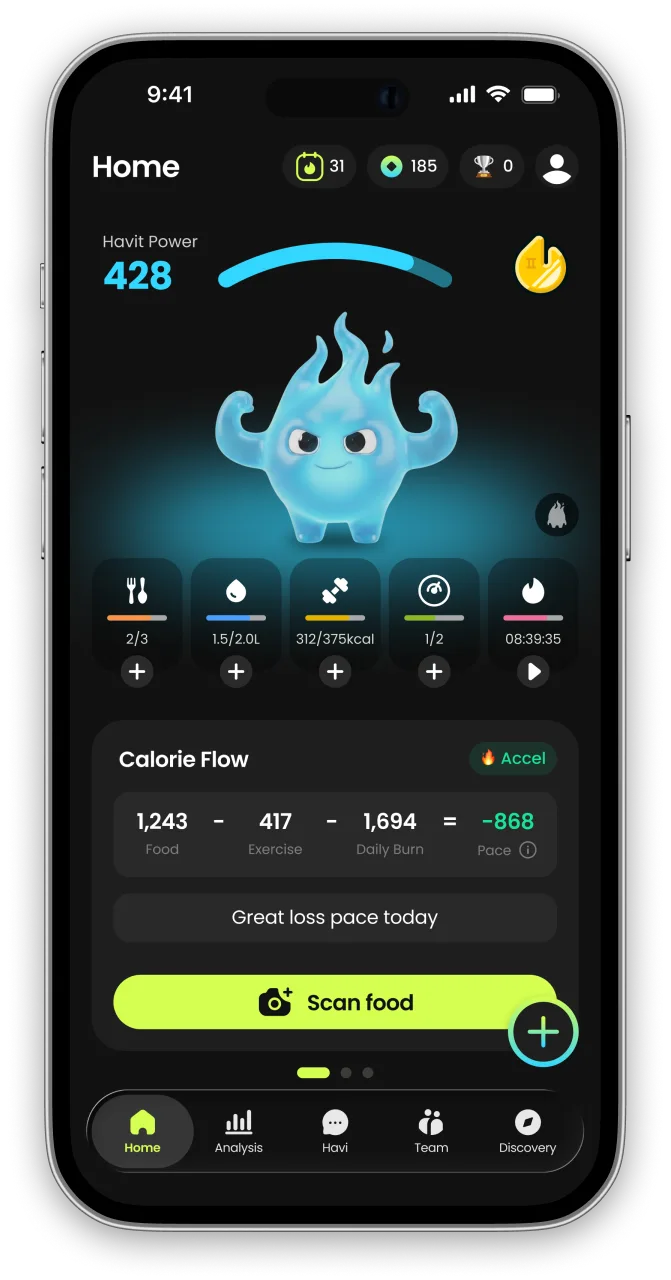
HAVIT brings your progress picture together with medication, food and protein logging, and habit-building nudges in one wellness app — so weight, body composition and non-scale wins live alongside the daily behaviours that protect your results.
If you want your whole GLP-1 journey in one place, it is a natural home for it. Want to compare dedicated tools first? See our best GLP-1 tracker apps roundup.
Safety basics for any GLP-1 log. Don't use these medicines if you or a close relative has had medullary thyroid cancer, or if you have MEN 2.
They are not used during pregnancy — tell your prescriber right away if you become pregnant or plan to, because some must be stopped weeks to months beforehand.
If you also take insulin or a sulfonylurea, watch for low blood sugar (shakiness, sweating, confusion).
Vomiting or diarrhea that keeps you from holding down fluids can dehydrate you and strain your kidneys — call your clinician.
A tracker organizes your records; the package leaflet in your country and your prescriber come first.
08
Why HAVIT — Medication + Behavior Change, in One App
GLP-1 medications can meaningfully reduce weight — but the number on the scale is only part of the story.
The lean-mass share of the weight lost on GLP-1 therapy has ranged from 40–60% in some trials to 15% or less in others — and lean mass counts organs, bone and fluid, not only muscle (Neeland et al., Diabetes, Obesity and Metabolism, 2024), and results tend to fade once the medication stops unless new habits take their place.
That's why leading guidance treats medication as one part of care, not the whole: the U.S. Preventive Services Task Force recommends that adults with obesity be offered intensive, multicomponent behavioral interventions (USPSTF, Grade B).
HAVIT is built for exactly this moment — one app that unites medication tracking, body composition, nutrition and protein, daily habit-building, and an AI coach that adapts to you.
Across our own 1,090 GLP-1 users, the most consistent trackers built the strongest habits (see the GLP-1 habit report).
Manage the medicine and the muscle — together. Start with HAVIT →

Preguntas frecuentes
What is a GLP-1 progress tracker?
How is a progress tracker different from a weight loss tracker?
What are non-scale victories on a GLP-1?
How do I know my progress is fat loss, not muscle loss?
Why is my weight flat but I look smaller?
How often should I take progress photos?
Is a plateau a sign my GLP-1 stopped working?
Do I need special equipment to track progress?
¿Qué es HAVIT?
HAVIT es un aliado de salud con IA basado en la ciencia del metabolismo: protege tu músculo, despierta tu metabolismo y te ayuda a mantener a largo plazo un cuerpo sano y sin efecto rebote.
A diferencia de las apps que solo cuentan calorías, HAVIT conecta estimaciones de composición corporal por IA con alimentación, hidratación, sueño, pasos, ciclo, estado de ánimo y medicación GLP-1 en una sola rutina diaria, de modo que el progreso se mide por composición corporal y no solo por el número de la báscula. Las misiones diarias convierten técnicas de cambio de conducta ya validadas en acciones pequeñas y repetibles, con la experiencia de profesionales que trabajaron en Juvis Diet, una de las principales clínicas metabólicas de Corea.
En el análisis propio de HAVIT sobre 1.090 usuarios de GLP-1, quienes registraron de forma constante construyeron hábitos más sólidos que el resto de usuarios. Leer el Informe de Hábitos GLP-1
Dentro de la app
- COACH DE IASabe qué hacer hoy.
- NUTRICIÓNRegistra comidas en segundos.
- COMPOSICIÓN CORPORALMira más allá del peso.
- MISIONES DIARIASCrea hábitos que puedas repetir.
- CHECK-IN DIARIOCuéntale a HAVI cómo va el día.
- REGÍSTRALO TODODel agua al GLP-1
- MENTE Y RECUPERACIÓNPara los días en que se acaba la fuerza de voluntad.


HAVIT funciona con o sin medicación GLP-1. Es una app de bienestar, no un dispositivo médico; los resultados de composición corporal son estimaciones.

Continúa en la app
Bienestar personalizado con tus propios datos


Referencias
- Wilding JPH, et al. Once-Weekly Semaglutide in Adults with Overweight or Obesity (STEP-1). New England Journal of Medicine, 2021. nejm.org
- Jastreboff AM, et al. Tirzepatide Once Weekly for the Treatment of Obesity (SURMOUNT-1). New England Journal of Medicine, 2022. nejm.org
- Neeland IJ, et al. Changes in lean body mass with GLP-1-based therapies. Diabetes, Obesity and Metabolism, 2024. dom-pubs.onlinelibrary.wiley.com
- National Institute for Health and Care Excellence (NICE) — Identifying and assessing overweight, obesity and central adiposity (waist-to-height ratio). nice.org.uk
- American Diabetes Association — New GLP-1 Therapies Enhance Quality of Weight Loss by Improving Muscle Preservation. diabetes.org
- Cleveland Clinic — GLP-1 Agonists: overview and use. my.clevelandclinic.org
- All medical claims verified against the cited journals, clinical guidance, and clinic materials as of July 2026. Figures are updated periodically — confirm current details with your prescriber.*


