
GLP-1 et périménopause : prise de poids et insuline (2026)

Cet article est fourni à titre d'information générale uniquement et ne remplace pas un avis, un diagnostic ou un traitement médical professionnel. Consultez toujours un professionnel de santé qualifié pour toute question concernant une affection médicale.
Réponse rapide
Les GLP-1 en périménopause sont utilisés pour traiter la prise de poids, l'insulinorésistance croissante et la graisse abdominale qui apparaissent pendant les années de transition — souvent alors que vous avez encore vos règles — et non la périménopause elle-même. Le sémaglutide (Ozempic, Wegovy) et le tirzépatide (Mounjaro, Zepbound) peuvent aider, mais les protéines et la musculation sont essentielles, car c'est à la périménopause que la perte de masse musculaire s'accélère.
La périménopause est la période de transition — généralement autour de la quarantaine — qui précède vos dernières règles.
Ce qui la distingue de la ménopause, c'est que les œstrogènes ne font pas que baisser : ils fluctuent de façon erratique, avec des pics et des chutes d'un mois à l'autre, tandis que la progestérone diminue progressivement.
Ces variations expliquent pourquoi le poids, l'humeur, le sommeil et la glycémie peuvent soudain sembler imprévisibles.
Point crucial : le changement métabolique commence ici, avant l'arrêt des règles : les recherches de l'étude SWAN ont montré qu'au début de la transition ménopausique, le rythme de prise de graisse a doublé et la masse maigre a commencé à diminuer (Greendale et al., JCI Insight 2019).
C'est pourquoi les agonistes des récepteurs du GLP-1 sont devenus un sujet de discussion courant en périménopause.
Cette page explique ce qu'ils peuvent apporter face à la prise de poids de la périménopause, au basculement vers l'insulinorésistance qui rend soudain le poids tenace, au risque de perte musculaire que vous devez activement gérer, et à ce qu'il faut suivre.
Il s'agit d'information, pas d'une prescription — et s'il existe une possibilité de grossesse, un GLP-1 n'est pas approprié.
01
Pourquoi la périménopause modifie votre poids — alors que vous avez encore vos règles
La prise de poids de la périménopause n'est pas une question de « volonté ». C'est un changement mesurable, dû à la fluctuation des œstrogènes combinée au vieillissement, et il commence plus tôt que la plupart des femmes ne le pensent.
Quatre changements comptent le plus, résumés dans le tableau ci-dessous.
Les œstrogènes améliorent normalement la sensibilité à l'insuline — ils aident le muscle à capter le glucose du sang (revue sur les œstrogènes et le métabolisme, PMC 2025).
Lorsque leur signal devient erratique en périménopause, l'insulinorésistance et la graisse abdominale augmentent ensemble, dans une boucle qui s'auto-entretient.
L'objectif en périménopause n'est donc pas seulement un chiffre plus bas sur la balance : c'est une meilleure sensibilité à l'insuline et moins de graisse viscérale, tout en préservant le muscle.
| Changement | Ce qui se passe en périménopause | Pourquoi c'est important |
|---|---|---|
| Fluctuation des œstrogènes | Les œstrogènes montent et descendent de façon erratique avant leur déclin final | Provoque des variations imprévisibles du poids, du sommeil et de l'appétit |
| Apparition de l'insulinorésistance | Le muscle répond moins bien à l'insuline à mesure que le signal des œstrogènes devient irrégulier | Le même repas à 45 ans élève davantage la glycémie et stocke plus de graisse qu'à 30 ans |
| Augmentation de la graisse viscérale (abdominale) | La graisse commence à se redistribuer des hanches et des cuisses vers l'abdomen | La graisse viscérale est plus risquée sur le plan métabolique et aggrave l'insulinorésistance |
| Perte de masse musculaire | Le rythme de prise de graisse double et la masse maigre diminue au début de la transition | Abaisse le métabolisme de repos et affaiblit le soutien osseux |
02
Un GLP-1 peut-il aider face à la prise de poids de la périménopause ?
Oui — mais il faut comprendre ce qu'il traite. Aucun GLP-1 n'est approuvé par la FDA pour la « périménopause ». Ces médicaments sont approuvés pour le diabète de type 2 et la gestion du poids à long terme, et de nombreuses femmes en périménopause y sont éligibles à ce titre.
Parce que les GLP-1 ralentissent la vidange gastrique, réduisent l'appétit via le cerveau et améliorent la sensibilité à l'insuline, ils agissent directement sur les deux problèmes que crée la périménopause — l'insulinorésistance croissante et l'augmentation de la graisse viscérale.
Repère pour la France : Wegovy et Mounjaro (tirzépatide, également indiqué dans l'obésité) sont des médicaments sur ordonnance ; selon l'ANSM, leur usage dans l'obésité s'inscrit en seconde intention, après échec d'une prise en charge nutritionnelle, et non pour une perte de poids esthétique.
L'aspect insulinique est ce qui rend les GLP-1 particulièrement logiques ici : la périménopause est souvent la première période où une femme devient insulinorésistante, et les GLP-1 ont été conçus autour de la voie des incrétines et de l'insuline.
Si vos difficultés ont commencé plus tôt en raison d'une affection hormonale, consultez GLP-1 et SOPK, qui partage le même mécanisme d'insulinorésistance.
Une réserve importante : les femmes en périménopause peuvent encore ovuler et concevoir. Les GLP-1 ne doivent pas être utilisés pendant la grossesse et le sémaglutide doit être arrêté au moins 2 mois avant une grossesse planifiée (notice FDA de Wegovy). Discutez avec votre médecin d'une contraception fiable. Si vous prenez une pilule contraceptive : les notices américaines du tirzépatide (Mounjaro, Zepbound) conseillent de passer à une méthode non orale ou d'ajouter une méthode barrière pendant 4 semaines après le début et pendant 4 semaines après chaque augmentation de dose. La notice de l'UE ne l'exige pas : demandez à votre médecin ce qui s'applique à vous.

03
Le risque de perte musculaire à gérer
C'est la section la plus importante pour la périménopause, car la perte musculaire s'accélère déjà à ce stade — pas plus tard.
Les données de SWAN montrent que la masse maigre commence à diminuer dès le tout début de la transition, et toute perte de poids significative s'y ajoute : des données d'essais randomisés indiquent que les traitements à base de GLP-1 entraînent généralement des réductions de masse maigre représentant environ 20–30 % du poids total perdu (revue sur la composition corporelle, PMC).
Selon les études, la fourchette est plus large — d'environ 15 % ou moins à 40–60 % du poids perdu (Neeland et al., 2024) — et la masse maigre comprend aussi les organes, les os et l'eau, pas seulement le muscle.
Pourquoi cela s'aggrave : moins de muscle signifie un métabolisme de repos plus bas (ce qui rend le poids plus difficile à maintenir), un soutien plus faible pour les os (qui commencent à s'amincir en périménopause) et une force réduite.
Perdre du poids en perdant une part disproportionnée de muscle peut vous laisser plus légère mais en moins bonne santé métabolique.
Ces mesures sont incontournables à cet âge :
- Privilégiez les protéines à chaque repas pour soutenir la synthèse des protéines musculaires.
- Faites de la musculation 2 à 3 fois par semaine — l'habitude la plus protectrice pour les muscles et les os.
- Perdez du poids progressivement, sans chute brutale, pour limiter la perte de masse maigre.
- Protégez vos os avec un apport suffisant en calcium et en vitamine D, et un suivi encadré par un médecin.
- Suivez la composition corporelle, pas seulement le poids, afin de repérer tôt la perte musculaire.
04
Périménopause ou ménopause : ne pas confondre les deux
Ce sont des stades différents, et l'accent du traitement diffère.
En périménopause, les œstrogènes fluctuent et l'enjeu est l'apparition de l'insulinorésistance et de la perte musculaire alors que vous avez encore vos règles. À la ménopause et après, les œstrogènes sont durablement bas et l'enjeu est la graisse viscérale installée et la perte osseuse.
Si vos règles se sont arrêtées depuis 12 mois, notre guide complémentaire, GLP-1 et ménopause, traite de la situation après la transition.
Pour un panorama général de la sécurité des médicaments à tout stade, consultez effets secondaires des GLP-1.

05
Que suivre sous GLP-1 en périménopause
Pendant la transition, les bons indicateurs passent du « poids » à « l'insuline, la composition corporelle et le cycle ». Suivez ceci :
| Ce qu'il faut suivre | Pourquoi c'est important en périménopause | Fréquence |
|---|---|---|
| Poids et tour de taille | La graisse abdominale viscérale est la vraie cible | Chaque semaine |
| Composition corporelle (muscle vs graisse) | La perte de masse maigre s'accélère déjà — repérez-la tôt | Chaque mois / à chaque scan |
| Apport en protéines | Protège le muscle pendant la perte de poids | Chaque jour |
| Séances de musculation | L'habitude la plus protectrice pour muscles et os | 2–3×/semaine |
| Changements du cycle / symptômes | La périménopause se définit par des cycles irréguliers | En continu |
| Glycémie / bilans prescrits par le médecin | L'insulinorésistance augmente | Selon le médecin |
| Effets secondaires digestifs | Tolérance et calendrier des doses | Au fur et à mesure |
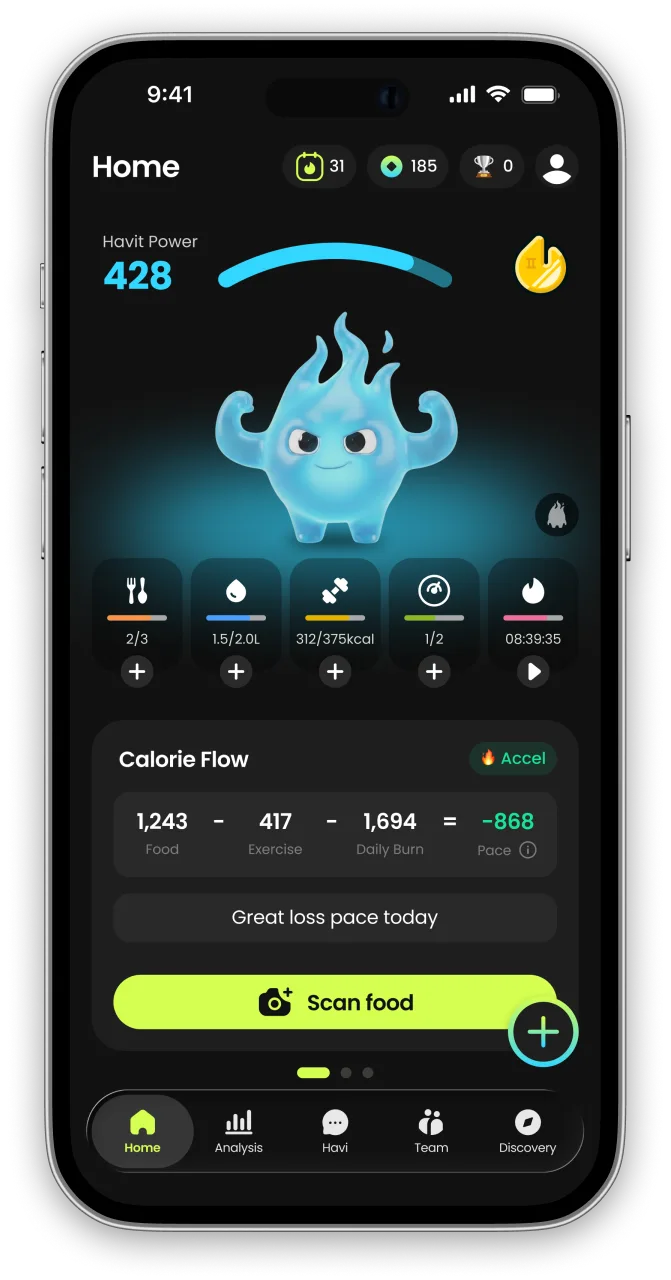
Enregistrer ensemble votre poids et votre tour de taille et vos protéines et votre musculation et votre cycle, c'est exactement ce que l'application HAVIT rend facile — pour vérifier que vous perdez de la graisse tout en conservant votre muscle, et apporter des données concrètes à votre consultation de périménopause ou d'endocrinologie. (HAVIT est un outil d'accompagnement et de suivi, pas un dispositif médical — en cas de doute, fiez-vous toujours à votre médecin.)
Toute personne qui hésite entre plusieurs options peut aussi commencer par le calculateur de perte de poids sous GLP-1.
06
Pourquoi HAVIT — Médicament + changement de comportement, dans une seule application
Les médicaments GLP-1 peuvent réduire sensiblement le poids — mais le chiffre sur la balance n'est qu'une partie de l'histoire.
La part de masse maigre dans le poids perdu sous traitement GLP-1 a varié de 40–60 % dans certains essais à 15 % ou moins dans d'autres — et la masse maigre inclut les organes, les os et l'eau, pas seulement les muscles (Neeland et al., Diabetes, Obesity and Metabolism, 2024).
Par ailleurs, les résultats tendent à s'estomper à l'arrêt du médicament, sauf si de nouvelles habitudes prennent le relais.
C'est pourquoi les recommandations de référence considèrent le médicament comme un élément de la prise en charge, et non comme un tout : l'U.S. Preventive Services Task Force recommande de proposer aux adultes en situation d'obésité des interventions comportementales intensives et multicomposantes (USPSTF, Grade B).
HAVIT est conçue pour ce moment précis — une seule application qui réunit le suivi du traitement, la composition corporelle, la nutrition et les protéines, la construction d'habitudes quotidiennes et un coach IA qui s'adapte à vous.
Parmi nos 1 090 utilisateurs de GLP-1, ceux qui suivaient le plus régulièrement leurs données ont construit les habitudes les plus solides (voir le rapport sur les habitudes GLP-1).
Gérez le médicament et le muscle — ensemble. Commencer avec HAVIT →

Questions fréquentes
Un GLP-1 est-il approuvé pour la périménopause ?
Pourquoi la prise de poids commence-t-elle en périménopause alors que j'ai encore mes règles ?
Un GLP-1 aide-t-il face à l'insulinorésistance de la périménopause ?
Vais-je perdre du muscle sous GLP-1 pendant la périménopause ?
Puis-je prendre un GLP-1 en périménopause si je peux encore tomber enceinte ?
Périménopause ou ménopause : quel article me concerne ?
Puis-je associer un GLP-1 à un traitement hormonal en périménopause ?
Le poids de la périménopause reviendra-t-il si j'arrête ?
Qu’est-ce que HAVIT ?
HAVIT est un partenaire santé IA fondé sur la science du métabolisme : il protège vos muscles, réveille votre métabolisme et vous aide à garder durablement un corps en bonne santé, sans effet yo-yo.
Contrairement aux applis qui ne comptent que les calories, HAVIT relie des estimations de composition corporelle par IA à l’alimentation, l’hydratation, le sommeil, les pas, le cycle, l’humeur et le traitement GLP-1 dans une seule routine quotidienne : les progrès se mesurent à la composition corporelle, pas au seul chiffre de la balance. Les missions quotidiennes traduisent des techniques de changement de comportement éprouvées en petites actions répétables, en s’appuyant sur l’expérience de professionnels passés par Juvis Diet, l’une des principales cliniques métaboliques de Corée.
Dans une analyse interne de HAVIT portant sur 1 090 utilisateurs de GLP-1, les personnes qui enregistraient régulièrement ont bâti des habitudes plus solides que l’ensemble des utilisateurs. Lire le rapport sur les habitudes GLP-1
Dans l’application
- COACH IASachez quoi faire aujourd'hui.
- NUTRITIONEnregistrez vos repas en quelques secondes.
- COMPOSITION CORPORELLEVoyez au-delà du poids.
- MISSIONS QUOTIDIENNESCréez des habitudes que vous tiendrez.
- CHECK-IN QUOTIDIENDites à HAVI comment va la journée.
- TOUT SUIVREDe l'eau au GLP-1
- MENTAL ET RÉCUPÉRATIONPour les jours où la volonté lâche.


HAVIT s’utilise avec ou sans traitement GLP-1. C’est une application de bien-être, pas un dispositif médical ; les résultats de composition corporelle sont des estimations.

Continuer dans l’app
Un bien-être personnalisé grâce à vos propres données


Références
- Greendale GA, et al. Changes in body composition and weight during the menopause transition (le rythme de prise de graisse double et la masse maigre diminue au début de la transition). JCI Insight, 2019. PMC. pmc.ncbi.nlm.nih.gov
- Estrogen and Metabolism: Navigating Hormonal Transitions from Perimenopause to Postmenopause (les œstrogènes favorisent la sensibilité à l'insuline). PMC, 2025. pmc.ncbi.nlm.nih.gov
- Increased visceral fat and decreased energy expenditure during the menopausal transition. PMC. pmc.ncbi.nlm.nih.gov
- The menopause transition and women's health at midlife: SWAN progress report. PMC. pmc.ncbi.nlm.nih.gov
- The Influence of GLP-1 Receptor Agonists on Body Composition (masse maigre ≈ 20–30 % du poids perdu). PMC. ncbi.nlm.nih.gov
- FDA — WEGOVY (semaglutide) Prescribing Information (grossesse : arrêter au moins 2 mois avant une grossesse planifiée). accessdata.fda.gov
- Mayo Clinic — Menopause weight gain: Stop the middle-age spread. mayoclinic.org
- Endocrine Society — Menopause and Bone Loss (bibliothèque pour les patients). endocrine.org
- Toutes les affirmations médicales ci-dessus ont été vérifiées à partir des études à comité de lecture, de la notice de la FDA et des grandes institutions cliniques citées, à la date de mi-2026. Les connaissances évoluent et les notices sont mises à jour régulièrement : confirmez les informations actuelles avec votre médecin.
- Eli Lilly — MOUNJARO prescribing information (rubrique 7.2, contraceptifs oraux) (checked 2026-10-16). pi.lilly.com
- EMA — Mounjaro EPAR product information (rubrique 4.1, indications dont la gestion du poids) (checked 2026-10-16). ema.europa.eu
- ANSM — Analogues du GLP-1 indiqués dans le traitement de l'obésité : l'ANSM fait évoluer leurs conditions de prescription et de délivrance (publié le 20/06/2025, mis à jour le 01/04/2026) (checked 2026-10-16). ansm.sante.fr


