
Best Habit Trackers for Weight Loss in 2026: Why Streaks Alone Fail

This article is for general informational purposes only and is not a substitute for professional medical advice, diagnosis, or treatment. Always consult a qualified healthcare provider with questions about a medical condition.
Quick answer
A tick cannot distinguish 30g of protein from the intention to eat it. A habit tracker helps only if it tracks a specific behaviour, verifies it from data, and adjusts when you miss instead of resetting.
A perfect 90-day streak and no weight lost is the signature failure of this category.
What is missing is not motivation. It is that "the thing" was never specified well enough to matter, and nothing in the app noticed.
This guide takes the habit apps one at a time.

01
What a habit tracker has to do
The standard taxonomy of behaviour-change interventions catalogues 93 discrete techniques. The ones that carry weight-loss results are specific: goal setting on behaviour rather than outcome, self-monitoring of that behaviour, feedback, action planning, and review when the plan fails.
Most habit apps implement exactly two — self-monitoring and a streak.
The streak problem. A streak's value is entirely in not breaking it, which means its value inverts the moment it breaks. Day 94 of a 93-day streak is the single most likely day to quit.
Look for repair mechanics: rest days, a weekly target instead of a daily one, credit for a partial log.
02
HAVIT — verified from data, not from a tick box
| Maker | Havit Inc. |
| Habit verification | From the log itself, not a check box |
| Tracks | Meals, hydration, workouts, sleep, steps, cycle, mood, GLP-1 |
| Mechanics | Daily missions · streaks · badges · avatars · ranks · team challenges |
| Price | Free · in-app purchases |

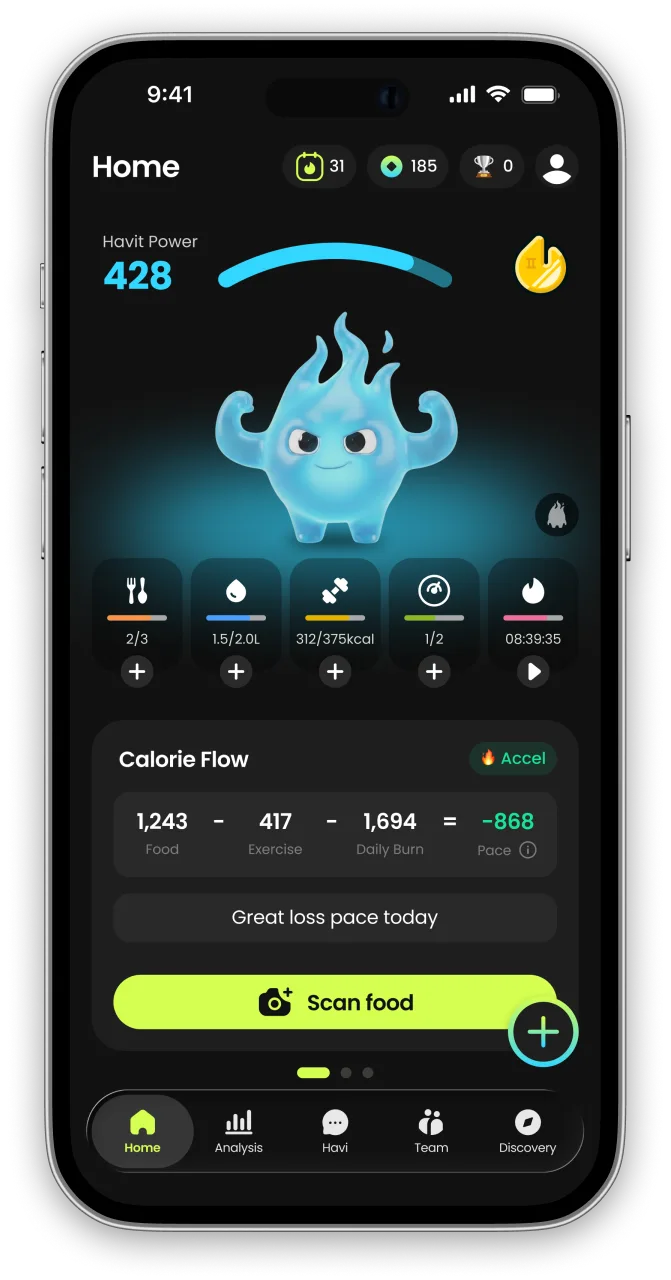
Verification is the whole difference. An app that only knows a check box is trusting a self-report made at 11pm. HAVIT knows whether you actually logged 40g of protein.
A tick cannot distinguish 30g of protein from the intention to eat it.
Daily missions are behaviour-change techniques in product form: one specific action, tied to data the app can actually see, adjusted when you miss it.

That last part is the design decision that matters.
A missed protein target is not a broken streak — it is an input. The AI coach reads it alongside sleep, steps and cycle, and the next day's ask changes.
The daily check-in is how a bad day enters the system without ending it.
Around that sit streaks, badges, avatars, ranks and team challenges, plus six guided-meditation tracks, workout video, fasting, 1,400+ articles and body-composition estimates.
Built with experts from Juvis Diet, a Korean diet clinic.
Who it suits: people whose ticks accumulated while their body did not change; people who deleted the app after one bad week.
03
Noom — curriculum and the weekly review
| Price | Subscription |
What it does well. A structured daily curriculum and a human coach who performs the weekly review — the technique almost every other app omits.
Where it falls down. It runs on its schedule rather than yours, and sits in the highest price bracket here.
Who it suits: people who want structure and a person checking in.
04
WeightWatchers — one number, decades of iteration
| Price | Subscription |
What it does well. Points reduce every food to one number, which is the most tested simplification in this field. Workshops add real accountability.
Where it falls down. Self-reported like the others, and the abstraction hides detail some people need.
Who it suits: people who want simplicity plus community.
05
Generic habit apps (Habitica, Streaks and similar)
What they do well. Track anything at all — guitar practice, flossing, water. Maximum flexibility.
Where they fall down. No verification. A tick knows only that you tapped it.
And they are not connected to any health data, so nothing can cross-reference the habit against an outcome.
Who they suit: people building ten unrelated habits.
06
Side by side
| App | What it records | Verification | On a missed day | Read alongside |
|---|---|---|---|---|
| HAVIT | The behaviour and its data | The log itself | Target adjusts, week continues | All 8 logs |
| Noom | Meals, activity, weight | Self-report | Coach reviews | Meals, activity |
| WeightWatchers | Points | Self-report | Weekly reset | Points, weight |
| Generic habit apps | A check box | None | Streak resets | Nothing |
App characteristics as of October 2026.
07
Habits that actually move weight — pick two
- 1
Protein at the first meal.
It matters more on GLP-1 medication, where the lean-mass share of weight lost has been reported as high as 40–60% in some trials.
- 2
Log every day, badly if necessary.
Completeness beats accuracy.
- 3
A fixed sleep window.
The habit people skip because it is not about food.
- 4
Resistance training twice a week.
- 5
One weekly review.
Look at the week and change one thing.
08
The bottom line
A habit tracker helps with weight only if it tracks a specific behaviour, can verify it from data rather than a tick, and adjusts when you miss instead of resetting.
Judge it on what it does on your worst day, not your best.

Frequently asked questions
What is the best habit tracker for weight loss?
Why do I keep a perfect streak but lose no weight?
Are streaks good or bad for weight loss?
What is the difference between a generic habit app and a weight-loss one?
Which habits actually move weight?
Should I track weight as a daily habit?
What is HAVIT?
HAVIT is an AI health partner built on metabolic science — it protects your muscle, wakes up your metabolism, and helps you keep a healthy, rebound-free body for the long run.
Unlike calorie-only trackers, HAVIT connects AI body-composition estimates, nutrition, hydration, sleep, steps, cycle, mood, and GLP-1 medication in one daily routine — so progress is measured by body composition, not just the number on the scale. Daily missions turn established behavior-change techniques into small repeatable actions, drawing on expertise from professionals formerly at Juvis Diet, one of Korea’s leading metabolic clinics.
In HAVIT’s own analysis of 1,090 GLP-1 users, people who logged consistently built stronger habits than the general user base. Read the GLP-1 Habit Report
Inside the app
- AI COACHA coach that reads your day.
- NUTRITIONLog meals in seconds.
- BODY INSIGHTSSee more than weight.
- DAILY MISSIONSBuild habits you can repeat.
- DAILY CHECK-INTell HAVI how today feels.
- TRACK EVERYTHINGFrom water to GLP-1
- MIND & RECOVERYFor the days willpower runs out.


HAVIT works with or without GLP-1 medication. It is a wellness app, not a medical device; body-composition results are estimates.
Continue in the App
Personalized wellness with your own data


References
- Self-monitoring in weight loss: a systematic review of the literature (Burke, Wang & Sevick) pmc.ncbi.nlm.nih.gov
- The behavior change technique taxonomy (v1) of 93 hierarchically clustered techniques (Michie et al.) pubmed.ncbi.nlm.nih.gov
- Reduction in the incidence of type 2 diabetes with lifestyle intervention or metformin — DPP (Knowler et al.) pmc.ncbi.nlm.nih.gov
- Changes in lean body mass with GLP-1-based therapies and mitigation strategies (Neeland et al.) pubmed.ncbi.nlm.nih.gov
- Weight loss to prevent obesity-related morbidity and mortality in adults: behavioral interventions — Grade B uspreventiveservicestaskforce.org
- How are habits formed: modelling habit formation in the real world (Lally, van Jaarsveld, Potts & Wardle) doi.org
- GLP-1 Habit Report 2026 — HAVIT internal analysis of 1,090 GLP-1 users aihavit.com


