Meditation for Food Cravings: A 5-Minute Urge Surfing Practice
A food craving grows when you replay it in your mind, so changing how you pay attention to it can take away its fuel. This 5-minute urge surfing meditation has you name the craving, breathe, locate it in your body and watch it rise and fall before choosing what to do. Studies on decentering, acceptance and mindful eating support trying short attention-based practices like this.
This article is for general informational purposes only and is not a substitute for professional medical advice, diagnosis, or treatment. Always consult a qualified healthcare provider with questions about a medical condition.
A food craving rarely arrives politely. It shows up as a picture of the thing you want, a voice that says "just a little," and a pull in the body that feels like it will only get stronger until you give in. Most people respond in one of two ways: they fight it with willpower, or they eat and feel bad afterwards.
There is a third option, and it takes about five minutes. It is called urge surfing: instead of fighting the wave or being knocked over by it, you watch it rise, peak and fall while you stay steady. This guide explains why a meditation for food cravings can help, walks you through a complete 5-minute practice with exact timings and words to say, and adds a section for people on GLP-1 medications who are learning to tell real hunger from leftover "food noise."
Why a Food Craving Feels So Urgent (and Why It Passes)
A craving is not the same as hunger. Hunger builds slowly, is usually open to many foods, and eases when you eat a reasonable amount. A craving tends to be sudden, specific (chocolate, chips, that one bakery item) and strongly tied to a mental image.
One influential explanation is the elaborated intrusion theory of desire, described in a randomized study published in Appetite in 2021. The idea is simple: a craving starts as an intrusive thought, and it grows when you elaborate on it in working memory, often as a vivid mental image. You picture the texture, the smell, the first bite. The more detail you add, the louder the craving becomes.
That gives us two useful insights:
- The thought itself is not the problem. An intrusive "I want cake" is normal. It is the elaboration, the mental replay, that feeds the urge.
- Attention is the lever. If you can change how you relate to the thought, without arguing with it, the craving has less fuel.
Cues matter too. In a randomized crossover trial published in Appetite in 2024, 63 young adults aged 18 to 24 browsed either a control Instagram feed or a feed rich in junk food images for 15 minutes; as the study title states, the junk food content negatively affected mood and cravings. If you notice cravings spiking after scrolling, that is not a character flaw. Your brain is responding to the cues it was shown.
Many people also find that a craving behaves like a wave: it builds, peaks and then fades, especially when they do not feed it with more imagery or with a fight. Urge surfing is built around that experience.
What Research Says About Meditation for Food Cravings
The research on mindfulness and cravings is still growing, and individual studies are often small. Here is what the studies behind this guide actually looked at, without stretching them.
Decentering versus visualisation. The 2021 Appetite study randomly assigned 108 participants to one of three conditions: mindfulness-based decentering, visualisation, or a mind-wandering control. Each group received short audio exercises, including a 2-minute exercise. Decentering means stepping back and seeing a thought as a passing mental event rather than an instruction. The researchers proposed that decentering may divert attention away from craving-related thoughts and images, while visualisation may occupy the visual working memory that cravings rely on. Both ideas appear in the practice below.
Acceptance versus control. An analog study published in Behaviour Research and Therapy in 2007 gave 98 undergraduate students transparent boxes of chocolates and asked them to carry the boxes for 48 hours without eating them. Before that, participants were randomized to no intervention, control-based strategies (such as distraction and cognitive restructuring), or acceptance-based strategies (such as experiential acceptance and defusion). The authors framed coping with cravings as critical to keeping weight off, which is why learning a repeatable skill matters more than white-knuckling one evening.
Mindfulness at the table. A randomized trial in the Journal of Consulting and Clinical Psychology (2019) compared a 4-session mindfulness and prolonged chewing program with a waitlist group (23 people in each). The program focused on eating more slowly and paying closer attention to bodily sensations, and as its title reports, it reduced body weight, food craving and emotional eating. That fits nicely with a broader habit of mindful eating and noticing satiety signals.
The honest summary: these studies support trying short, attention-based practices for cravings, and they suggest that how you relate to a craving matters. They do not promise that one meditation will make cravings disappear.
The 5-Minute Urge Surfing Meditation, Step by Step
You can do this sitting, standing in a kitchen or even in a bathroom stall at work. Set a timer for five minutes if you can, and agree with yourself on one rule: you will not decide whether to eat until the timer ends. Afterwards, you are free to choose either way.
Minute 0:00–0:30 — Stop and name it. Put down whatever is in your hand. Plant both feet. Say quietly, "This is a craving." Naming it creates a small gap between you and the urge.
Minute 0:30–1:30 — Three slow breaths, then normal breathing. Breathe in through the nose for about 4 counts and out through the mouth for about 6 counts. Do this three times, letting the out-breath be longer than the in-breath. Then let your breathing return to its natural pace. If you want more breathing options, the 4-7-8 technique works well here too.
Minute 1:30–2:30 — Find the craving in your body. Ask: "Where do I feel this?" Common places are the mouth (watering, a taste), the throat, the chest or the stomach. Rate the intensity from 0 to 10. Describe it in plain words: tight, warm, buzzing, hollow. You are studying it, not obeying it.
Minute 2:30–3:30 — Surf the wave. Imagine the craving as a wave and your breath as a surfboard. With each in-breath, notice the sensation; with each out-breath, let your shoulders and jaw soften. If a picture of the food appears, do not push it away. Label it, "There's the image," and gently return to the body sensation. This is decentering in practice: the thought is allowed to be there, but you are not elaborating on it.
Minute 3:30–4:30 — Watch it change. Re-rate the intensity from 0 to 10. It may be higher, lower or the same. All three are fine. Notice whether the sensation has moved or changed texture. Many people find that a craving shifts more than they expect when they simply watch it.
Minute 4:30–5:00 — Choose on purpose. Ask: "Am I physically hungry, or is this a craving? What do I actually need right now?" Maybe it is water, a real meal, a break, or the food itself in a portion you decide calmly. Whatever you pick, pick it consciously. Eating after urge surfing is not a failure; it is a decision instead of an autopilot reaction.
Posture tips: Sit or stand tall but relaxed, hands resting on your thighs or stomach. Eyes can be closed or softly lowered. If you are around other people, simply look at a fixed point on the floor.
Scripts You Can Say to Yourself
Words help when the urge is loud. Pick one or two that feel natural and use them every time so they become a cue.
- "This is a craving. Cravings rise and fall."
- "I don't have to decide right now. I'll decide in five minutes."
- "There's the picture of the food. I see it, and I'm going back to my breath."
- "This feeling is uncomfortable, and I can handle uncomfortable."
- "What do I need right now: food, rest, comfort or a break?"
Avoid scripts that sound like punishment ("You have no self-control"). Harsh self-talk tends to raise stress, and stress is a common trigger in itself. If you notice a pattern of eating when upset, our guides on interrupting the emotional eating trigger and the companion meditation for emotional and stress eating go deeper.
When the "Craving" Is Food Noise: A Note for GLP-1 Users
Many people taking GLP-1 medications describe a big drop in "food noise," the constant background chatter about food. Yet some notice that urges still pop up: at a familiar time of day, after an ad, or out of habit when bored. Physical hunger may be lower, but the learned cue-and-reward loop can still fire.
Urge surfing is useful here because it helps separate three signals:
- Physical hunger: gradual, open to many foods, eased by a normal meal.
- Habit or cue-driven urges: linked to a time, place, feed or emotion.
- Fullness and nausea signals: which on these medications can arrive earlier than you are used to.
During the last minute of the practice, ask specifically: "Is my stomach asking for food, or is my routine?" If you are on a GLP-1 medication, eating past fullness can feel especially uncomfortable, so pausing for five minutes before an unplanned snack is a gentle way to listen to your body. For more on how food noise changes, read how GLP-1 medications reduce food noise. Always follow your prescriber's advice on eating patterns and nutrition while on medication.
Making It Stick: When and Where to Practice
A skill that only appears during emergencies is hard to use. Build it in calm moments so it is ready when cravings hit.
- Practice once a day without a craving. Do the 5-minute routine with any small urge, like wanting to check your phone. The steps are the same.
- Anchor it to a cue. Do it before opening the fridge after work, or when you reach for snacks in the evening.
- Reduce cue exposure where you can. If certain feeds or accounts set off cravings, mute them during the hours you are most vulnerable.
- Track, don't judge. Write down the starting and ending intensity. Over a couple of weeks, you will see your own pattern.
The comparison below summarises the three common ways people respond to a craving.
Try This Meditation in the HAVIT App
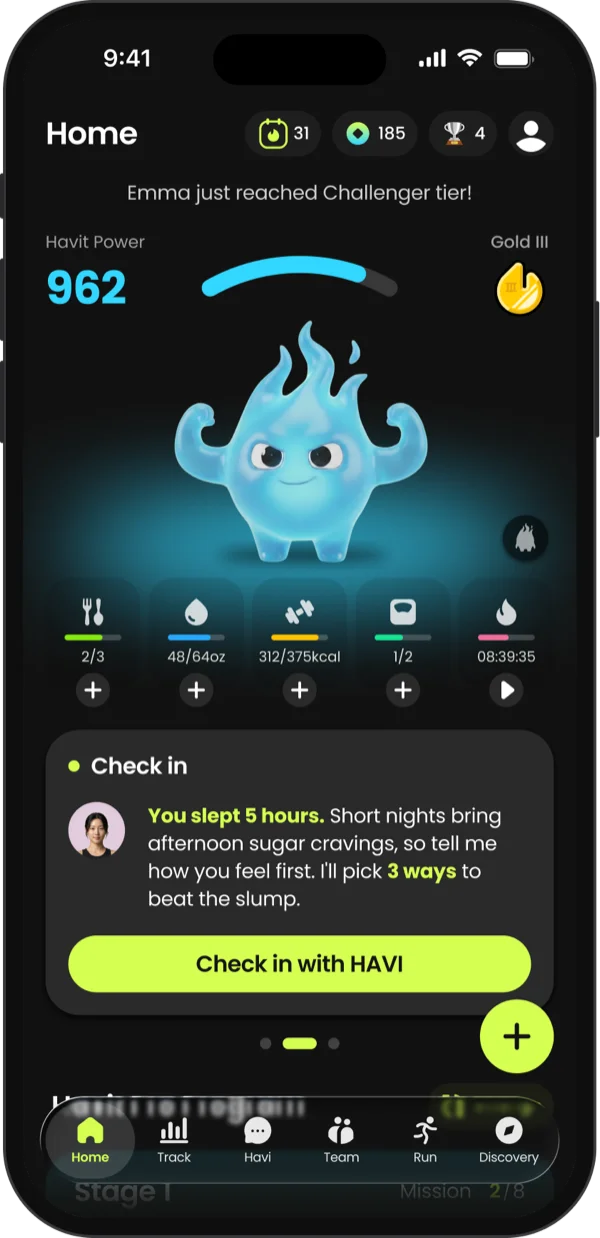
If you would rather be guided than count the minutes yourself, the HAVIT app has guided meditation videos in five categories: Breathing & relaxation, Sleep, Focus & morning energy, Self-compassion & gratitude, and Cravings & appetite, which is designed to help you calm your mind before eating so impulsive eating and overeating are less likely.
When you first start, you can pick the meditation categories you are interested in. Because food, exercise and sleep logging and the AI coach HAVI all live in one app, you can notice when cravings tend to show up and talk through patterns with HAVI. For the full series, start with the guided meditation for weight loss and healthy habits hub.
This article is for general information. If cravings feel out of control, or you are dealing with binge eating, an eating disorder, anxiety or depression, please talk to a doctor or qualified mental health professional.
📊 Key Stats
Three Ways to Respond to a Food Craving
| Approach | What you do | What tends to happen | Best used when |
|---|---|---|---|
| Fighting it | Argue with the thought, try to suppress it | Attention stays locked on the food | Rarely the best first move |
| Distraction | Switch to a different activity | Can help briefly, craving may return | You can leave the situation |
| Urge surfing | Notice, breathe, observe the wave, then choose | You decide calmly instead of reacting | Any time, especially at home |
General comparison for everyday use, not a clinical ranking.
❓ Frequently Asked Questions
Can meditation really help with food cravings?
What is urge surfing?
How long does a food craving last?
Is it okay to eat the food after urge surfing?
Does urge surfing work for GLP-1 food noise?
What if cravings feel out of control?
What is HAVIT?
HAVIT is an AI health partner built on metabolic science — it protects your muscle, wakes up your metabolism, and helps you keep a healthy, rebound-free body for the long run.
Unlike calorie-only trackers, HAVIT connects AI body-composition estimates, nutrition, hydration, sleep, steps, cycle, mood, and GLP-1 medication in one daily routine — so progress is measured by body composition, not just the number on the scale. Daily missions turn established behavior-change techniques into small repeatable actions, drawing on expertise from professionals formerly at Juvis Diet, one of Korea’s leading metabolic clinics.
In HAVIT’s own analysis of 1,090 GLP-1 users, people who logged consistently built stronger habits than the general user base. Read the GLP-1 Habit Report
Inside the app
- AI COACHA coach that reads your day.
- WORKOUT & RUNNINGFrom home workouts to your next run.
- NUTRITIONLog meals in seconds.
- BODY INSIGHTSSee more than weight.
- DAILY MISSIONSBuild habits you can repeat.
- DAILY CHECK-INTell HAVI how today feels.
- TRACK EVERYTHINGFrom water to GLP-1
- MIND & RECOVERYFor the days willpower runs out.


HAVIT works with or without GLP-1 medication. It is a wellness app, not a medical device; body-composition results are estimates.

Continue in the App
Personalized wellness with your own data


References
- The effect of visualisation and mindfulness-based decentering on chocolate craving — Appetite, 2021
- A combined mindfulness-prolonged chewing intervention reduces body weight, food craving, and emotional eating — Journal of consulting and clinical psychology, 2019
- A comparison of acceptance- and control-based strategies for coping with food cravings: an analog study — Behaviour research and therapy, 2007
- Exposure to Instagram junk food content negatively impacts mood and cravings in young adults: A randomized controlled trial — Appetite, 2024