Morning Meditation for Focus and Energy: A 5-Minute Step-by-Step Routine
A 5-minute morning meditation trains the skill behind focus: noticing a wandering mind and bringing it back. Research is most encouraging for short practice repeated daily over weeks, not for a single session, so the routine below is designed to be easy to repeat every morning.
This article is for general informational purposes only and is not a substitute for professional medical advice, diagnosis, or treatment. Always consult a qualified healthcare provider with questions about a medical condition.
Most mornings start in reactive mode: an alarm, a phone screen, a list of messages, and a mind already racing toward the day's first problem. A short morning meditation is a simple way to flip that order. Instead of letting the inbox set your attention, you spend five minutes deliberately choosing where your attention goes, and then you carry that choice into the day.
This guide gives you a complete, follow-along 5-minute morning meditation for focus and energy, explains honestly what research does and does not show about brief meditation and attention, and offers variations for sleepy, rushed, or restless mornings.
Why a 5-minute morning meditation can help your focus
Focus is not only about willpower. It is largely about noticing when your mind has drifted and bringing it back, again and again. Meditation trains exactly that skill. Each time you notice a wandering thought and return to the breath, you rehearse the same mental move you need later when an email, a notification, or a worry pulls you off task.
Morning is a practical time to rehearse this for a few reasons:
- Fewer interruptions. Before the day fills up, it is easier to protect five quiet minutes.
- It sets the tone. Many people find that starting calmly and intentionally makes them less reactive for the next few hours.
- It anchors a habit. Linking meditation to something you already do every morning, like brushing your teeth or making coffee, makes it far easier to repeat.
- Energy without a jolt. A focused breathing practice with an upright posture can feel gently energizing, rather than sedating like an evening wind-down.
Five minutes is deliberately small. The goal is a practice short enough that you will actually do it on a busy Tuesday, not an ideal session you skip four days out of seven.
What the research says (and what it does not)
It is worth being precise here, because brief meditation is often oversold.
Daily practice over weeks looks promising. In a randomized study published in Behavioural Brain Research (2019), adults aged 18 to 45 with no meditation experience did either a 13-minute daily guided meditation or 13 minutes of daily podcast listening for 8 weeks. The meditation group showed improvements in attention, memory, mood and emotional regulation compared with the podcast group. The key details: the participants were beginners, and the practice was short but daily.
Short courses can reduce mind wandering. A randomized controlled study in Psychological Science (2013) found that a 2-week mindfulness training course improved reading-comprehension scores on the GRE and working memory capacity, while reducing distracting thoughts during those tasks. The improvements were linked to less mind wandering, which is exactly the skill a morning practice rehearses.
Brief formats are being studied for emotional benefits. Researchers writing in Frontiers in Neuroscience (2019) developed a 15-minute brief mindfulness meditation and reported that it improved emotion processing. Brief formats are attractive precisely because classic programs demand a lot of time.
One session is not a magic switch. A study in Brain Sciences (2021) compared a single 15-minute session of mindful breathing with a 15-minute mind-wandering exercise, in one experiment with 82 participants and another with 424. It did not find evidence that the single session improved working memory capacity.
Put together, the honest takeaway is this: do not expect one five-minute sit to transform your concentration that same morning. The more encouraging findings come from practice repeated over days and weeks. That is why the rest of this guide focuses on making a short routine easy to repeat.
Before you start: a 60-second setup
You do not need special equipment. You need a place, a posture, and a timer.
- Pick your spot. A chair, the edge of your bed, or a cushion on the floor all work. Choose the same spot each morning if you can.
- Sit upright. For a morning focus practice, posture matters. Sit with your feet flat on the floor, spine tall but not stiff, shoulders relaxed, and hands resting on your thighs. Lying down tends to invite sleep, so save that for evening practice.
- Set a timer for 5 minutes. Use a gentle sound. Put your phone face down or in another mode so messages do not appear.
- Let in some light. If possible, open the curtains or sit near a window. Many people find daylight helps them feel more awake.
- Decide your intention. Choose one short phrase for the day, such as "one thing at a time" or "steady and clear."
Eyes can be closed or open with a soft downward gaze. If you feel drowsy, keep them open.
The 5-minute morning meditation, step by step
Read through this once, then follow it from memory or with a guided recording. Suggested words to say silently are in quotes.
Minute 0:00 to 1:00 — Arrive and wake up the body
- Take three slightly deeper breaths: in through the nose for about 4 counts, out through the mouth for about 6 counts.
- On each exhale, let your shoulders drop a little.
- Gently roll your shoulders back twice and lengthen through the crown of your head.
- Silently say: "I am here. This is my five minutes."
Minute 1:00 to 2:30 — Counting breaths for focus
- Let your breathing return to a natural rhythm through the nose.
- Count each exhale: one, two, three, up to ten. Then start again at one.
- If you lose count or realize you are planning your day, simply notice it, label it "thinking," and return to one.
- Losing count is not failure. Every return is one repetition of the focus skill.
Minute 2:30 to 3:30 — Energizing breath
- Breathe in through the nose for 4 counts, filling the belly and then the chest.
- Breathe out through the nose for 4 counts.
- Keep the rhythm even and comfortable, sitting tall. Imagine the inhale bringing alertness up the spine.
- If you feel lightheaded at any point, return to natural breathing.
Minute 3:30 to 4:30 — Set your focus intention
- Return to natural breathing.
- Bring to mind the single most important task of your day. Picture yourself starting it, calmly, with your full attention.
- Silently repeat your intention phrase on the exhale: "One thing at a time."
- Notice any resistance or worry about the task. You do not need to fix it; just acknowledge it.
Minute 4:30 to 5:00 — Transition into the day
- Widen your attention to the sounds in the room and the feeling of your feet on the floor.
- Take one final full breath in, and a slow breath out.
- Open your eyes, and before you pick up your phone, decide the first concrete action you will take.
That last step matters. The few seconds after you open your eyes are where the practice either carries into your morning or dissolves into the inbox.
If you would like more detail on breathing patterns, see our guide to box breathing for anxiety and focus, which works well as an alternative to the energizing breath.
Variations for different kinds of mornings
Not every morning looks the same. Adjust the routine rather than skipping it.
- Sleepy mornings: Keep your eyes open, sit near a window, and spend more time on the energizing breath. Some people stand for the whole practice.
- Rushed mornings: Do a 2-minute version: one minute of counting breaths and one minute of intention setting. Something small still keeps the habit alive.
- Anxious mornings: Lengthen the exhale (in for 4, out for 6 to 8) instead of the even energizing breath. A longer exhale often feels calming.
- Restless mornings: Add a body anchor. Press your feet into the floor on each exhale, or notice the touch of your hands on your legs.
- Shared spaces: Use earphones with a guided recording, or practice in the car before you go into work, with the engine off.
If you are completely new to meditation, our guide to 5-minute meditation for beginners covers the basics of posture and handling a wandering mind.
Making it stick: building a morning habit
Because the stronger findings come from regular practice, consistency is the real goal. A few practical strategies:
- Stack it. Attach meditation to an existing habit: "After I pour my coffee, I sit for five minutes."
- Keep the bar low. On difficult days, one minute counts. The habit matters more than the length.
- Prepare the night before. Leave your cushion or chair in place, and set the timer in advance.
- Track it simply. A check mark on a calendar or a note in an app helps you see your streak and notice patterns.
- Notice effects over weeks, not minutes. Pay attention to whether you get back on task more easily after distractions over the next couple of weeks.
- Be kind when you miss a day. Restart the next morning without judgment. Self-criticism tends to make habits harder, not easier.
Meditation is a wellness practice, not a medical treatment. If you are dealing with severe insomnia, persistent anxiety, ongoing difficulty concentrating, or an eating disorder, please talk to a qualified healthcare professional.
For a wider view of how meditation can support everyday healthy habits, read our guide to guided meditation for weight loss and healthy habits.
Try this meditation in the HAVIT app
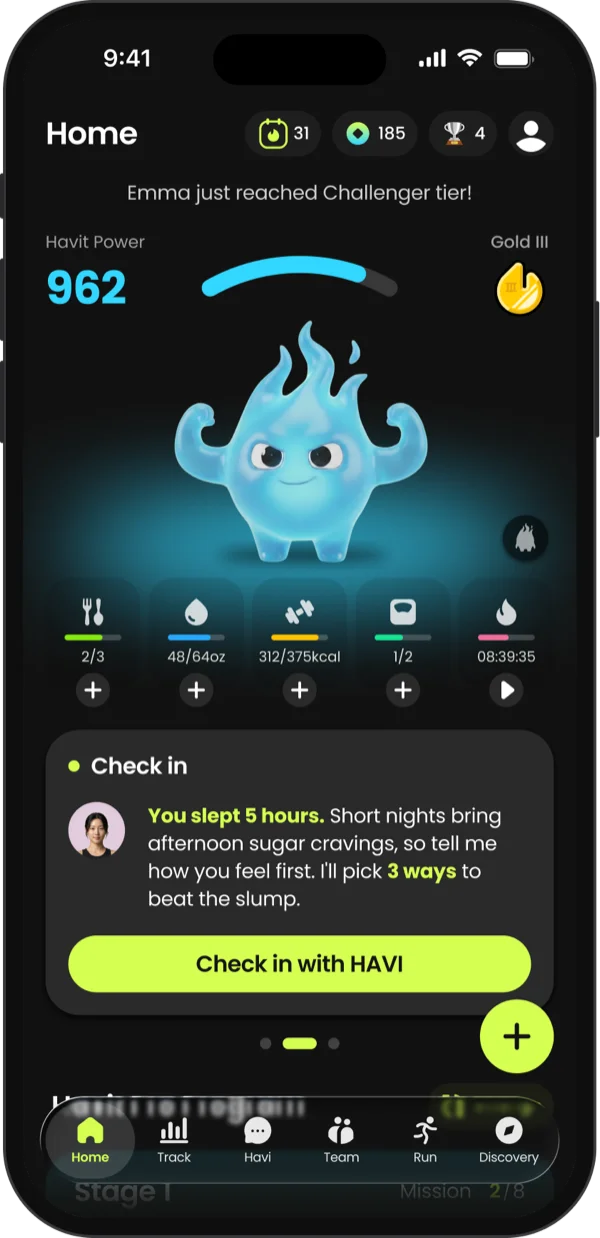
If you prefer to be guided, the HAVIT app includes guided meditation videos organized into five categories: Breathing & relaxation, Sleep, Focus & morning energy, Self-compassion & gratitude, and Cravings & appetite. The Focus & morning energy category is the natural match for this routine.
When you first start, you can choose the meditation category you are most interested in. And because meal, exercise and sleep logging and the AI coach HAVI all live in the same app, your morning practice can sit alongside the rest of your daily health routine instead of in a separate tool.
📊 Key Stats
Adjusting the 5-Minute Routine to Your Morning
| Morning type | Main change | Breathing | Posture |
|---|---|---|---|
| Standard | Follow all five steps | Count exhales, then even 4-in/4-out | Seated, upright |
| Sleepy | More time on energizing breath | Even 4-in/4-out | Eyes open, near a window or standing |
| Rushed | 2-minute version | Count exhales for 1 minute | Wherever you are |
| Anxious | Longer exhale | In 4, out 6 to 8 | Seated, feet grounded |
| Restless | Add a body anchor | Natural breath | Press feet into the floor |
Practical adjustments based on common experience; choose what feels comfortable.
❓ Frequently Asked Questions
Is 5 minutes of meditation in the morning enough to help focus?
What is the best time to meditate in the morning?
Should I meditate before or after coffee?
Why do I feel sleepy when I meditate in the morning?
Can I do morning meditation lying in bed?
How long before I notice a difference in focus?
What is HAVIT?
HAVIT is an AI health partner built on metabolic science — it protects your muscle, wakes up your metabolism, and helps you keep a healthy, rebound-free body for the long run.
Unlike calorie-only trackers, HAVIT connects AI body-composition estimates, nutrition, hydration, sleep, steps, cycle, mood, and GLP-1 medication in one daily routine — so progress is measured by body composition, not just the number on the scale. Daily missions turn established behavior-change techniques into small repeatable actions, drawing on expertise from professionals formerly at Juvis Diet, one of Korea’s leading metabolic clinics.
In HAVIT’s own analysis of 1,090 GLP-1 users, people who logged consistently built stronger habits than the general user base. Read the GLP-1 Habit Report
Inside the app
- AI COACHA coach that reads your day.
- WORKOUT & RUNNINGFrom home workouts to your next run.
- NUTRITIONLog meals in seconds.
- BODY INSIGHTSSee more than weight.
- DAILY MISSIONSBuild habits you can repeat.
- DAILY CHECK-INTell HAVI how today feels.
- TRACK EVERYTHINGFrom water to GLP-1
- MIND & RECOVERYFor the days willpower runs out.


HAVIT works with or without GLP-1 medication. It is a wellness app, not a medical device; body-composition results are estimates.

Continue in the App
Personalized wellness with your own data


References
- Brief, daily meditation enhances attention, memory, mood, and emotional regulation in non-experienced meditators — Behavioural brain research, 2019
- Mindfulness training improves working memory capacity and GRE performance while reducing mind wandering — Psychological science, 2013
- Brief Mindfulness Meditation Improves Emotion Processing — Frontiers in neuroscience, 2019
- Brief Mindfulness Breathing Exercises and Working Memory Capacity: Findings from Two Experimental Approaches — Brain sciences, 2021