Meditation for Beginners: A 5-Minute Practice You Can Do Anywhere
Beginner meditation is simply noticing when your mind wanders and gently returning to an anchor like the breath; each return is the practice. Start with a 5-minute daily session tied to an existing routine. Randomized trials in novice meditators have studied short daily, app-guided sessions and reported reduced stress.
This article is for general informational purposes only and is not a substitute for professional medical advice, diagnosis, or treatment. Always consult a qualified healthcare provider with questions about a medical condition.
Meditation for beginners does not need a cushion, a quiet retreat, or an hour of free time. It needs five minutes, a place to sit or stand, and a simple set of instructions you can follow without thinking too hard. This guide gives you exactly that: how to sit, how to breathe, what to say to yourself, what to do when your mind wanders (it will), and how to turn one five-minute session into a daily habit.
If you have tried meditating before and felt like you were "bad at it," this guide is especially for you. Wandering attention is not a failure. Noticing it and coming back is the practice itself.
What meditation actually is (and isn't) for beginners
Most beginner-friendly meditation is a form of mindfulness: paying attention to what is happening right now, such as your breath, sounds, or body sensations, without judging it or trying to fix it. You are not trying to empty your mind, stop thinking, or reach a special state.
A useful way to picture it:
- The anchor is something you can return to at any moment. For most beginners, this is the breath.
- The wandering is your mind drifting to plans, memories, worries, or to-do lists. This is normal and constant.
- The return is the moment you notice you have drifted and gently bring attention back to the anchor.
Each return is one "repetition," much like a single rep in a workout. A five-minute session where your mind wanders twenty times and you come back twenty times is a productive session, not a failed one.
What meditation is not: a replacement for medical or psychological treatment. If you are dealing with severe anxiety, insomnia, depression, or an eating disorder, please talk to a qualified healthcare professional; meditation can be a helpful companion to care, not a substitute for it.
Getting set up: posture, place, and timing
You can meditate almost anywhere: at your desk, on a park bench, in a parked car, on your bed, or standing in a queue. What matters is a posture that is both relaxed and alert.
Seated on a chair (the easiest option)
- Sit toward the front half of the seat so your back is not slumped against the backrest.
- Place both feet flat on the floor, roughly hip-width apart.
- Let your spine lengthen upward as if a string were gently lifting the crown of your head.
- Rest your hands on your thighs, palms down or up, whichever feels natural.
- Soften your shoulders, jaw, and the muscles around your eyes.
On the floor
Sit cross-legged on a folded blanket or cushion so your hips are slightly higher than your knees. This takes pressure off the lower back.
Lying down
Fine if you have back pain or want to relax before sleep, but beginners often drift off. If you want to stay awake, bend your knees with feet flat on the floor.
Standing
Feet hip-width apart, knees soft, arms relaxed at your sides. Useful in a busy office or while waiting.
Eyes: close them, or keep them half-open with a soft gaze resting on a spot about a metre in front of you.
Timing: pick a moment you already have every day, such as after brushing your teeth, before opening your laptop, or right after lunch. Set a gentle timer for five minutes so you are not checking the clock.
The 5-minute beginner meditation, step by step
Here is a complete session you can follow today. The times are approximate; nothing bad happens if you are off by a few seconds.
Minute 0:00 to 0:30 — Arrive
Settle into your posture. Take one slightly deeper breath in through the nose and let it go slowly through the mouth. Silently say: "For the next five minutes, I don't need to do anything else."
Minute 0:30 to 1:30 — Feel the body
Notice where your body makes contact: feet on the floor, weight on the seat, hands on your legs. Move your attention slowly from the top of your head down to your feet, letting each area soften a little as you pass through it. You are not trying to relax perfectly, only noticing.
Minute 1:30 to 4:00 — Follow the breath
Let the breath return to its natural rhythm. Do not control it. Choose one place where you feel it most clearly: the cool air at the nostrils, the rise and fall of the chest, or the belly gently expanding.
To give your mind something to hold on to, count breaths silently:
- Breathe in... breathe out... "one."
- Breathe in... breathe out... "two."
- Continue up to five, then start again at one.
If you lose count or find yourself at "fourteen," smile and begin again at one. That moment of noticing is the skill you are training.
If counting feels mechanical, use a short phrase instead: "breathing in" on the inhale and "breathing out" on the exhale.
Minute 4:00 to 4:30 — Widen your attention
Let go of the breath as a focus. Open your awareness to everything at once: sounds in the room, the temperature of the air, your whole body sitting here. Just let it all be as it is.
Minute 4:30 to 5:00 — Close
Take one fuller breath. Wiggle your fingers and toes. Before you open your eyes, notice one thing: how do you feel right now compared with five minutes ago? There is no right answer. Then open your eyes and continue your day.
If you want a calmer, slower rhythm for stressful moments, you can swap the counting section for a structured technique such as box breathing, or explore a longer breathing and relaxation meditation.
What to do when your mind wanders
This is the question every beginner asks, and the honest answer is: your mind will wander, often within seconds. The goal is not to stop it, but to change how you respond.
Use the "notice, name, return" method:
- Notice that you are no longer with the breath.
- Name where the mind went with a single soft word: "planning," "worrying," "remembering," "hearing."
- Return to the next breath, starting your count again at one.
Be kind about it. Many beginners scold themselves ("I can't even do five minutes"). That reaction is just another thought. Try treating yourself the way you would treat a friend learning something new. If self-criticism shows up often, you may find a self-compassion meditation a helpful next step.
When a strong emotion or itch appears: instead of reacting immediately, give it three breaths of curious attention. Where do you feel it? Does it change? If you still need to scratch or shift, do it slowly and mindfully, then return to the breath.
When you feel sleepy: open your eyes slightly, sit a little taller, or try the standing posture.
When you feel restless: shorten the session to three minutes, or count each exhale only. Short and consistent beats long and dreaded.
What the research says about short, beginner-level practice
Research on meditation for complete beginners is still growing, but several randomized controlled trials have specifically studied people new to meditation using short, guided sessions, often delivered through a smartphone.
- A randomized controlled trial published in Mindfulness (2018) compared novice meditators using an introductory mindfulness meditation program in a smartphone app with a control group listening to an audiobook introduction to mindfulness concepts. As the title of the paper reports, the brief app-based training was followed by improvements in stress, affect, and irritability.
- A study in Annals of Behavioral Medicine (2025) randomized 138 non-faculty university employees to an app-based mindfulness meditation program and tracked stress in everyday life across an eight-week intervention period, rather than relying only on before-and-after questionnaires. The authors report that app-based mindfulness meditation reduced stress in these novice meditators.
- In a trial in Applied Psychology: Health and Well-Being (2022), 64 working university students were randomized either to a mindfulness app or to a wait-list. The intervention group was asked to complete one 10 to 15 minute session per day, with outcomes measured after eight weeks; the study reports reduced perceived stress and improved self-regulation.
- A paper in Neural Plasticity (2020) notes that earlier randomized trials by the same research group found white matter changes surrounding the anterior and posterior cingulate cortex within two to four weeks after 5 to 10 hours of mindfulness training in novices, and investigated whether short-term practice (under 30 days) also affects gray matter.
What this means in practice: these studies used short daily sessions and simple, guided formats, not lengthy retreats. Five minutes is a realistic starting point that you can extend to ten or fifteen as the habit settles in. Results vary between people, and none of these studies show that meditation alone treats a medical condition.
Building a daily habit that sticks
Knowing how to meditate is the easy part. Doing it on an ordinary Tuesday is harder. These strategies help:
Anchor it to an existing routine. "After I pour my morning coffee, I sit for five minutes" is easier to remember than "I'll meditate sometime today."
Make it small enough to never skip. On busy days, one minute counts. The aim in the first weeks is to protect the streak of showing up, not to perfect each session.
Use guidance at first. A guided recording removes the guesswork about what to do next. Many beginners find it easier to stay with a voice than with silence.
Track it lightly. A simple checkmark on a calendar or in an app helps you see progress. Pair it with how you felt afterwards, in one word.
Expect a dip. Motivation often fades after the first week or two. That is the moment to shrink the session, not quit it.
Grow it gradually. Once five minutes feels easy for a couple of weeks, try seven, then ten. Or add a second short session, such as a calming practice before bed.
A simple four-week plan:
- Week 1: 3 to 5 minutes daily, guided, same time each day.
- Week 2: 5 minutes daily; try the breath-counting method on your own once or twice.
- Week 3: 5 to 7 minutes; experiment with a different location (desk, outdoors, bed).
- Week 4: 7 to 10 minutes, or two 5-minute sessions on stressful days.
Common beginner problems and quick fixes
| Problem | Quick fix |
|---|---|
| "I can't stop thinking." | You don't need to. Count each return as a successful rep. |
| "I keep falling asleep." | Sit upright, open your eyes slightly, meditate earlier in the day. |
| "I don't have time." | Start with one minute after a daily habit you already do. |
| "It feels boring." | Switch anchors: sounds, body sensations, or a guided session. |
| "My back hurts." | Use a chair with feet flat, or lie down with knees bent. |
| "I feel more anxious." | Keep your eyes open, focus on your feet on the floor, shorten the session. |
If meditation consistently makes you feel worse, stop and consider speaking with a professional. A small number of people find inward-focused practice uncomfortable, especially during periods of high distress, and that is useful information, not a personal failure.
Try this meditation in the HAVIT app
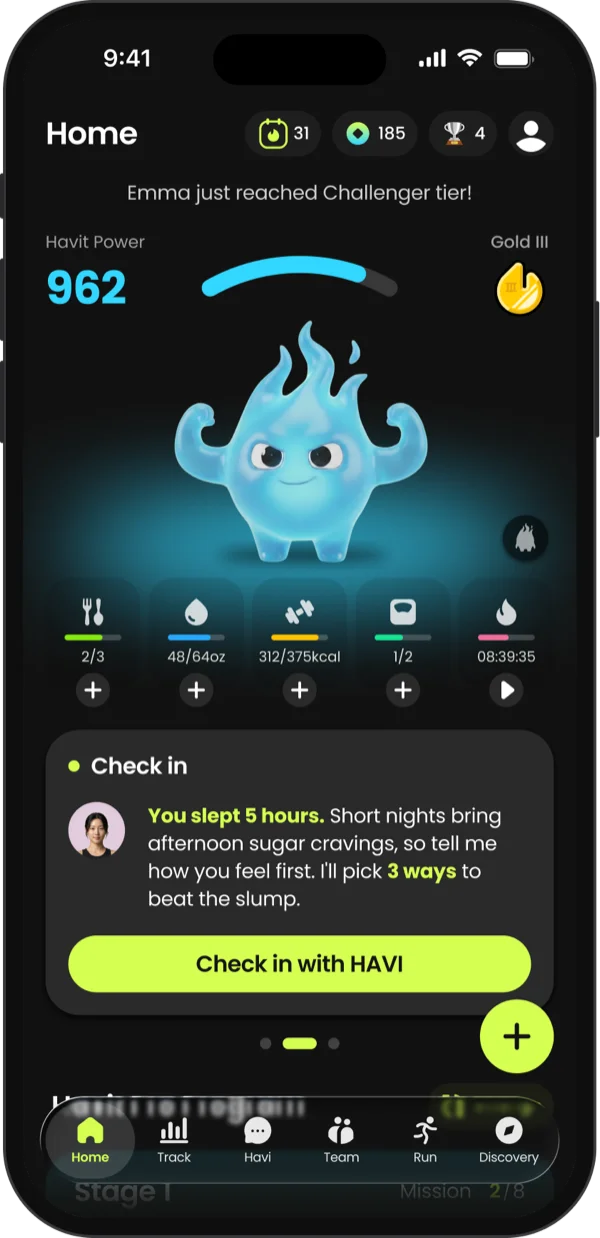
If you would like a voice to guide you through the first weeks, the HAVIT app includes guided meditation videos organized into five categories: Breathing & relaxation, Sleep, Focus & morning energy, Self-compassion & gratitude, and Cravings & appetite, which focuses on calming the mind before a meal to reduce impulsive eating and overeating.
When you first start, you can choose the meditation category you are most interested in. For a beginner, Breathing & relaxation is a natural starting point, since it builds the same breath-anchor skill described in this guide. Because HAVIT also brings together meal, exercise, and sleep logging with an AI coach (HAVI) in one app, your short meditation can sit right next to the other healthy habits you are building.
To see how meditation fits into a broader approach to healthy habits, read our guided meditation guide for weight loss and healthy habits.
📊 Key Stats
Beginner Meditation Postures Compared
| Posture | Best for | Watch out for |
|---|---|---|
| Chair, feet flat | Desk, home, first sessions | Slumping against the backrest |
| Cross-legged on cushion | Quiet home practice | Knee or hip strain without a cushion |
| Lying down | Back pain, before sleep | Falling asleep |
| Standing | Office, queues, restlessness | Locking the knees |
Choose the posture that keeps you both relaxed and alert; you can switch any time.
❓ Frequently Asked Questions
How long should a beginner meditate?
Is it normal that my mind keeps wandering?
What is the best time of day to meditate?
Do I need to sit cross-legged?
Can I meditate with an app as a complete beginner?
What if meditation makes me feel more anxious?
What is HAVIT?
HAVIT is an AI health partner built on metabolic science — it protects your muscle, wakes up your metabolism, and helps you keep a healthy, rebound-free body for the long run.
Unlike calorie-only trackers, HAVIT connects AI body-composition estimates, nutrition, hydration, sleep, steps, cycle, mood, and GLP-1 medication in one daily routine — so progress is measured by body composition, not just the number on the scale. Daily missions turn established behavior-change techniques into small repeatable actions, drawing on expertise from professionals formerly at Juvis Diet, one of Korea’s leading metabolic clinics.
In HAVIT’s own analysis of 1,090 GLP-1 users, people who logged consistently built stronger habits than the general user base. Read the GLP-1 Habit Report
Inside the app
- AI COACHA coach that reads your day.
- WORKOUT & RUNNINGFrom home workouts to your next run.
- NUTRITIONLog meals in seconds.
- BODY INSIGHTSSee more than weight.
- DAILY MISSIONSBuild habits you can repeat.
- DAILY CHECK-INTell HAVI how today feels.
- TRACK EVERYTHINGFrom water to GLP-1
- MIND & RECOVERYFor the days willpower runs out.


HAVIT works with or without GLP-1 medication. It is a wellness app, not a medical device; body-composition results are estimates.

Continue in the App
Personalized wellness with your own data


References
- Improvements in Stress, Affect, and Irritability Following Brief Use of a Mindfulness-based Smartphone App: A Randomized Controlled Trial — Mindfulness, 2018
- App-based mindfulness meditation reduces stress in novice meditators: a randomized controlled trial of headspace using ecological momentary assessment — Annals of behavioral medicine : a publication of the Society of Behavioral Medicine, 2025
- App-based mindfulness meditation reduces perceived stress and improves self-regulation in working university students: A randomised controlled trial — Applied psychology. Health and well-being, 2022
- Brief Mindfulness Meditation Induces Gray Matter Changes in a Brain Hub — Neural plasticity, 2020