Guided Meditation for Weight Loss: 5 Types for Healthy Habits
Research suggests mindfulness and meditation change eating behaviors such as impulsive, binge and external eating more reliably than they change body weight directly. Use guided meditation to pause before autopilot eating, manage stress and sleep, and recover from slips, alongside the basics of diet and activity. Start with a 10-minute session and one category that fits your biggest challenge.
This article is for general informational purposes only and is not a substitute for professional medical advice, diagnosis, or treatment. Always consult a qualified healthcare provider with questions about a medical condition.
Most weight-loss advice focuses on what to eat and how much to move. Far less attention goes to the moment that actually decides most outcomes: the few seconds between a trigger (stress, boredom, a long day, the smell of something sweet) and what you do next. Guided meditation for weight loss is about that gap. It will not burn fat on its own, but it can help you notice what is happening inside you before autopilot takes over.
This guide is the hub for our meditation series. It explains what the research does and does not show, walks you through the five kinds of guided meditation that matter most for healthy habits, gives you a 10-minute starter session you can follow today, and links to a dedicated step-by-step article for each situation.
What guided meditation can (and can't) do for weight loss
Guided meditation means following a voice, a script or a video that leads your attention: to your breath, to sensations in your body, to thoughts and urges as they come and go. For people trying to lose weight or keep it off, the practical goal is not "emptying the mind." It is building three skills:
- Noticing: recognizing hunger, fullness, stress and cravings as separate signals instead of one vague "I want to eat."
- Pausing: creating a short break between an urge and the action, so a choice becomes possible.
- Recovering: getting back on track after a slip without the harsh self-talk that often leads to more overeating.
What meditation does not do is replace the basics. Calories, protein, sleep and daily movement still drive body weight. Think of meditation as the support system that makes those basics easier to follow on a hard day, not as a shortcut.
What the research actually says
The honest summary is: mindfulness and meditation look more reliable for changing eating behaviors than for directly moving the number on the scale.
- A meta-analysis in Obesity research & clinical practice (2017) pooled 12 randomised controlled trials in adults with overweight and obesity. Mindfulness training had no significant effect on weight loss in that analysis, but it had a large effect on reducing impulsive eating (d = -1.13) and binge eating (d = -0.90).
- A broader review in Obesity Reviews (2018) analyzed 18 publications covering 19 studies and 1,160 participants to evaluate mindfulness-based interventions for weight loss and obesity-related eating behaviours, noting that earlier reviews had produced inconsistent results.
- A more recent meta-analysis in Obesity Reviews (2025) looked at "obesogenic" eating habits. Mindfulness-based programs were linked with less external eating (g = -0.62), less hunger-driven eating (g = -0.69), better fullness awareness (g = 0.64) and more controlled eating (g = 0.23).
- A systematic review in Eating behaviors (2014) examined 14 studies where mindfulness meditation was the main intervention and concluded that it effectively decreases binge eating.
- For emotional eating specifically, a meta-analysis in the International journal of environmental research and public health (2023) brought together 34 studies of interventions for adults living with overweight or obesity.
What this means for you: use meditation to change how you eat (speed, triggers, autopilot, stress responses), and let those behavior changes support your weight goals over time. Do not expect a meditation habit alone to produce weight loss.
Five kinds of guided meditation and when to use each
Different moments call for different practices. Here is how the five main categories line up with real situations, with a full guide for each.
1. Breathing and relaxation: for stress spikes. When your shoulders are tight and your thoughts are racing, a few minutes of slow breathing helps you come down before you reach for food. Start with our breathing and relaxation meditation for stress and anxiety.
2. Sleep: for late-night snacking and poor rest. Many people notice that a poor night's sleep makes cravings harder to manage the next day. A body scan in bed shifts attention away from the day's worries. Follow the 10-minute body scan sleep meditation.
3. Focus and morning energy: for setting intentions. A few calm minutes after waking lets you decide how you want the day to go, including meals, before the day decides for you. Try the 5-minute morning meditation for focus and energy.
4. Self-compassion and gratitude: for slips and motivation dips. One overeating episode often turns into a "ruined day" because of self-criticism. Self-compassion practice helps you reset instead. See the self-compassion meditation for weight-loss motivation.
5. Cravings and appetite: for the moment before you eat. Calming the mind before a meal can reduce impulsive eating and overeating. Use the 5-minute meditation for food cravings, and if your eating is driven by stress or emotions, read the meditation for emotional and stress eating.
Completely new to meditation? Begin with 5-minute meditation for beginners you can do anywhere, then add the category that fits your biggest challenge.
A 10-minute starter session you can try today
This session combines a little of each skill. Read it once, then follow along, or record yourself reading it slowly.
Setup (30 seconds). Sit on a chair with both feet on the floor, back upright but not stiff, hands resting on your thighs. Close your eyes or lower your gaze to a spot on the floor. Set a gentle timer for 10 minutes.
Minutes 0-2: Arrive with the breath. Breathe in through your nose for a count of 4, and out slowly for a count of 6. Repeat about 10 times. Silently say: "Breathing in, I arrive. Breathing out, I let the day settle." If your mind wanders, that is normal. Notice where it went and come back to the count.
Minutes 2-5: Quick body scan. Let the breath return to its natural rhythm. Move your attention slowly from the top of your head down to your feet: forehead, jaw, shoulders, chest, belly, hips, legs, feet. At each area, notice tension and invite it to soften on the out-breath. Pay special attention to your belly. Is it empty, comfortable, full, or tight from stress? Just observe; there is no right answer.
Minutes 5-7: Hunger check-in. Ask yourself: "On a scale from 1 (starving) to 10 (stuffed), where am I right now?" Then ask: "If I want to eat, is it my body asking, or is it stress, tiredness or boredom?" Label whatever you find with one word, such as "hungry," "tired," "anxious" or "fine."
Minutes 7-9: Kind intention. Place a hand on your chest. Say silently: "Whatever I ate yesterday, today is a new start. I can take care of my body one choice at a time." Picture one small, concrete action for the next few hours: drinking water before lunch, eating your next meal slowly, or going for a short walk.
Minutes 9-10: Return. Take three deeper breaths. Wiggle your fingers and toes. Open your eyes and notice the room before you stand up.
That is it. Ten minutes, no special equipment. If 10 minutes feels like too much, do only the first two minutes. A short practice you repeat daily is worth more than a long one you skip.
Matching meditation to your day: a simple weekly plan
You do not need to do all five categories every day. Pick one anchor practice, then add situational ones when you need them.
| Time | Practice | Length | Purpose |
|---|---|---|---|
| After waking | Morning focus | 3-5 min | Set one food or movement intention |
| Before your largest meal | Cravings and appetite | 2-5 min | Check hunger, slow down |
| After a stressful moment | Breathing and relaxation | 2-3 min | Lower tension before eating |
| After a slip | Self-compassion | 5 min | Reset without guilt |
| In bed | Sleep body scan | 10 min | Wind down, avoid late snacking |
A realistic starting week might look like this: morning meditation on weekdays, a pre-meal pause before dinner every day, and a body scan on any night you feel wired. Add the others as specific situations show up.
Making the habit stick
Meditation is a habit like any other, so the same rules apply.
- Attach it to something you already do. "After I pour my coffee, I meditate for three minutes" works better than "I'll meditate sometime today."
- Keep the first version tiny. Two minutes is enough to start. You can lengthen it once it feels automatic.
- Track it next to your meals. Many people find patterns quickly when they see meditation days next to their food log, for example fewer evening snacks on days with a pre-dinner pause.
- Expect wandering. A wandering mind is not failure. Each time you notice and return, you are practicing exactly the skill that helps with cravings.
- Do not use meditation as punishment. It is not a penalty for overeating. Treat it as a tool you choose, not a chore you owe.
Common mistakes to avoid: waiting for a quiet, perfect moment; judging a session as "good" or "bad"; and quitting after a week because the scale did not move. Look instead for behavior signs, such as eating more slowly or pausing before a snack.
A note on safety: if you are dealing with severe insomnia, persistent anxiety, or binge eating that feels out of control, please talk with a doctor or mental health professional. Meditation can complement care but is not a substitute for it.
Try these meditations in the HAVIT app
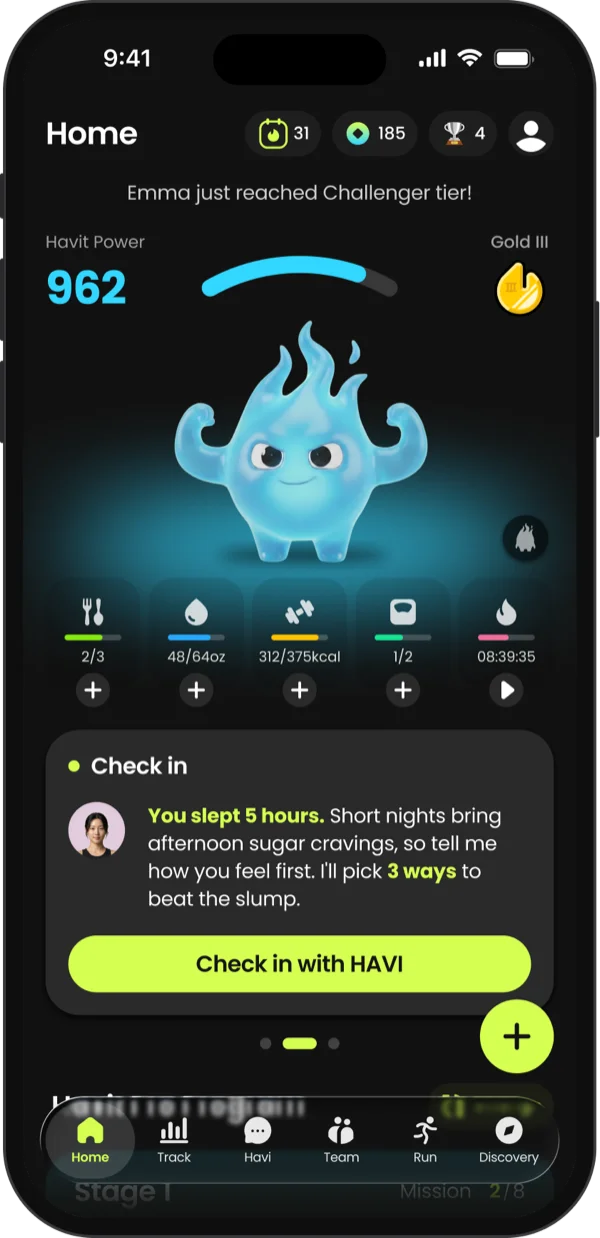
HAVIT includes guided meditation videos organized into the same five categories covered in this guide: Breathing & relaxation, Sleep, Focus & morning energy, Self-compassion & gratitude, and Cravings & appetite, which is designed to help you settle your mind before a meal to reduce impulsive eating and overeating.
When you first set up the app, you can choose the meditation categories that interest you most. Because your meal, exercise and sleep logs live in the same app alongside HAVI, the AI coach, it is easier to see how a pre-meal pause or a better night's sleep connects to the rest of your habits.
Start with one category that matches your biggest challenge right now, practice it for a week, and build from there.
📊 Key Stats
Five guided meditation types and when to use them
| Category | Best moment | Main skill |
|---|---|---|
| Breathing & relaxation | After a stressful moment | Calming tension before eating |
| Sleep | In bed at night | Winding down, avoiding late snacking |
| Focus & morning energy | After waking | Setting food and movement intentions |
| Self-compassion & gratitude | After a slip | Resetting without guilt |
| Cravings & appetite | Before meals | Pausing impulsive eating and overeating |
A practical guide to matching meditation type to situation.
❓ Frequently Asked Questions
Can guided meditation help you lose weight?
What type of meditation is best for weight loss?
How long should I meditate each day for healthy eating habits?
When is the best time to meditate for weight loss?
Does meditation help with emotional eating and cravings?
Is a meditation app or video better than meditating alone?
What is HAVIT?
HAVIT is an AI health partner built on metabolic science — it protects your muscle, wakes up your metabolism, and helps you keep a healthy, rebound-free body for the long run.
Unlike calorie-only trackers, HAVIT connects AI body-composition estimates, nutrition, hydration, sleep, steps, cycle, mood, and GLP-1 medication in one daily routine — so progress is measured by body composition, not just the number on the scale. Daily missions turn established behavior-change techniques into small repeatable actions, drawing on expertise from professionals formerly at Juvis Diet, one of Korea’s leading metabolic clinics.
In HAVIT’s own analysis of 1,090 GLP-1 users, people who logged consistently built stronger habits than the general user base. Read the GLP-1 Habit Report
Inside the app
- AI COACHA coach that reads your day.
- WORKOUT & RUNNINGFrom home workouts to your next run.
- NUTRITIONLog meals in seconds.
- BODY INSIGHTSSee more than weight.
- DAILY MISSIONSBuild habits you can repeat.
- DAILY CHECK-INTell HAVI how today feels.
- TRACK EVERYTHINGFrom water to GLP-1
- MIND & RECOVERYFor the days willpower runs out.


HAVIT works with or without GLP-1 medication. It is a wellness app, not a medical device; body-composition results are estimates.

Continue in the App
Personalized wellness with your own data


References
- Mindfulness-based interventions for weight loss: a systematic review and meta-analysis — Obesity reviews : an official journal of the International Association for the Study of Obesity, 2018
- The effects of mindfulness training on weight-loss and health-related behaviours in adults with overweight and obesity: A systematic review and meta-analysis — Obesity research & clinical practice, 2017
- Effects of mindfulness-based interventions on obesogenic eating behaviors: A systematic review and meta-analysis — Obesity reviews : an official journal of the International Association for the Study of Obesity, 2025
- Mindfulness meditation as an intervention for binge eating, emotional eating, and weight loss: a systematic review — Eating behaviors, 2014
- Emotional Eating Interventions for Adults Living with Overweight or Obesity: A Systematic Review and Meta-Analysis — International journal of environmental research and public health, 2023