Self-Compassion Meditation for Weight Loss: What to Do After Overeating
Harsh self-criticism after overeating often fuels more eating, while self-compassion interventions were designed to reduce self-criticism and show promise for health behaviours. This guide gives you a 7-minute self-compassion meditation for right after a slip and a 3-minute gratitude practice for the next morning.
This article is for general informational purposes only and is not a substitute for professional medical advice, diagnosis, or treatment. Always consult a qualified healthcare provider with questions about a medical condition.
You ate more than you planned. Maybe it was a second plate at dinner, a bag of chips on the couch, or dessert you swore you would skip. What happens in the next ten minutes often matters more for your long-term progress than the food itself. For many people, the next ten minutes sound like this: "I have no willpower. I ruined the whole week. I might as well keep going and start over on Monday."
This guide offers a different response: a short self-compassion meditation you can do right after overeating, plus a gratitude add-on for the next morning. It is not about excusing the slip. It is about getting back on track faster, without the guilt hangover that tends to trigger the next round of eating.
Why the "I blew it" spiral derails diets
Most diets do not fail because of one big meal. They fail because of what that meal sets off. A common pattern looks like this:
- The slip. You eat more than planned.
- The verdict. Your inner critic turns one meal into a judgment about who you are: lazy, weak, hopeless.
- The emotional crash. Shame, frustration, and stress pile up.
- The escape. Food is a fast way to numb those feelings, so the eating continues.
- The reset fantasy. "I'll be perfect starting Monday," which sets up the next all-or-nothing cycle.
Notice that the harsh self-talk in step 2 does not stop step 4. It often fuels it. Being cruel to yourself feels like taking responsibility, but in practice it adds more stress to a system that is already looking for relief. If this loop feels familiar, our guide to interrupting emotional eating triggers breaks down the trigger-response pattern in more detail.
Self-compassion targets step 2 directly. Instead of a verdict, you give yourself the kind of response you would give a friend who just told you the same story: honest, warm, and focused on the next good step.
What the research says about self-compassion and eating
Self-compassion is usually described as the tendency or ability to treat yourself kindly in times of failure or distress. Researchers have started asking whether that skill helps with eating and weight.
- Weight management. A systematic review in the Journal of Psychosomatic Research (2021) noted that self-compassion may be a natural fit for people who struggle with weight management and shows promise for improving health behaviours. The same review is careful to say that its direct links to weight outcomes are still unclear. In other words, the evidence is encouraging for behaviour, but self-compassion is not a weight-loss shortcut.
- Self-criticism. A meta-analysis in Clinical Psychology & Psychotherapy (2022) identified 20 randomized controlled trials of self-compassion-related interventions, with 19 papers and 1,350 participants included in the analysis, to estimate how these programs affect self-criticism. Self-compassion interventions were developed specifically to target self-criticism, which is exactly the voice that shows up after overeating.
- Stress and eating. A study of 136 first-year university students in New Zealand, published in Psychology & Health (2024), examined whether self-compassion buffers the path from stress to unhealthy eating and weight change. The researchers expected students low in self-compassion to respond to stress with unhealthy eating.
- Mindful eating. A survey of 349 university students in The Journal of Psychology (2022) started from the observation that mindful eating and self-compassion have each been shown to contribute to healthy eating, and explored how the two relate to eating attitudes and wellbeing.
- Gratitude. A preregistered meta-analysis in PNAS (2025), pooling 24,804 participants from 28 countries, found that gratitude interventions led to small overall increases in well-being (Hedges' g = 0.19).
The honest summary: self-compassion is a promising tool for the emotional side of eating, especially for quieting self-criticism. Gratitude practice gives a small but real lift to well-being. Neither replaces a sensible eating plan, but both can make that plan easier to return to.
Self-compassion vs. letting yourself off the hook
A common worry is that being kind to yourself will make you lazy. Self-compassion is not the same as saying "it doesn't matter" or "I deserve to eat whatever I want." It has three working parts:
- Mindfulness: naming what happened and how you feel without exaggerating it. "I ate past full and I feel uncomfortable and disappointed."
- Common humanity: remembering that overeating is an ordinary human experience, not proof that you are uniquely broken.
- Self-kindness: responding with warmth and a practical next step, the way a good coach would.
The key difference is direction. Self-criticism looks backward and asks "what is wrong with me?" Self-compassion looks forward and asks "what do I need right now, and what will help tomorrow?" We compare the two approaches in depth in self-compassion vs. self-criticism for behavior change.
The 7-minute after-overeating self-compassion meditation
Use this right after a meal that went further than planned, or later that evening when the guilt kicks in. You can do it sitting on the couch, at your desk, or even in a parked car.
Before you start: loosen any tight clothing, put your phone on silent, and set a gentle timer for 7 minutes if you like.
Step 1 - Settle the body (1 minute) Sit with your feet flat on the floor and your back supported. Let your hands rest on your thighs or your belly. Breathe in through your nose for a count of 4, and out through your mouth for a count of 6. Repeat five or six times. The longer exhale is a simple way to signal to yourself that the emergency is over.
Step 2 - Name what happened, plainly (1 minute) Silently describe the facts, like a news reporter, not a judge. "I ate a large dinner and then snacks. My stomach feels full. I feel guilty and frustrated." If a harsh label pops up ("disgusting," "hopeless"), notice it and say to yourself, "That's the critic talking," then return to the facts.
Step 3 - Feel it in the body (1 minute) Gently scan for where the emotion lives: a tight chest, heat in the face, heaviness in the stomach. Rest one hand on that area. Breathe into it slowly. You are not trying to make the feeling disappear, only to stay with it for a few breaths without running from it.
Step 4 - Remember you are not alone (1 minute) Say quietly: "Overeating is part of being human. Many people trying to change their habits feel exactly this tonight." Picture someone you care about telling you they had the same evening. Notice how you would respond to them.
Step 5 - Offer yourself kindness (2 minutes) Keep a hand on your chest or belly. Repeat a few phrases slowly, pausing between each one. Choose words that feel believable to you:
- "This is a hard moment."
- "May I be kind to myself right now."
- "One meal does not undo my progress."
- "I can care for myself without punishing myself." If kind words feel fake, try a neutral version: "I'm allowed to feel this and still make a good choice next."
Step 6 - Choose one caring next step (1 minute) Ask: "What would help me most in the next hour?" Keep it small and kind, not compensatory. Good examples: drink a glass of water, take a 10-minute walk, brush your teeth to close the kitchen for the night, or plan a normal, balanced breakfast. Avoid "punishment" plans like skipping meals tomorrow, which tend to restart the cycle.
Finish with three slow breaths and open your eyes.
A 3-minute gratitude add-on for the next morning
The morning after a heavy evening is when the "I'll start over Monday" thinking is strongest. A short gratitude practice shifts attention from what went wrong to what is still working.
- Breathe (30 seconds). Sit up in bed or at the table. Take three slow breaths.
- Thank your body (1 minute). Name one thing your body did for you yesterday: it carried you through work, digested a big meal, let you hug someone. Say, "Thank you for that."
- Spot one win (1 minute). Recall one thing you did well in your health routine this week, no matter how small: a walk, a vegetable-heavy lunch, going to bed on time.
- Set today's intention (30 seconds). Finish the sentence: "Today I'll take care of myself by..." and choose one doable action.
The gratitude meta-analysis above found effects that were small on average, so think of this as a gentle daily nudge rather than a dramatic fix. Its main job here is to break the all-or-nothing story and get you back to your normal routine today, not next week.
Making it stick: when and how often to practice
- Practice when calm, too. Skills are easier to use in a hard moment if you have rehearsed them. Try the 7-minute meditation two or three times a week even on good days.
- Pair it with a cue. After dinner dishes, before bed, or right after you log a meal are natural anchors.
- Shorten when needed. If 7 minutes feels like too much, do Steps 1, 2, and 5 only. That takes about 3 minutes.
- Track patterns, not just calories. Note when the "I blew it" spiral shows up: late evenings, stressful workdays, weekends. Patterns tell you where to place the practice. If stress is the main driver, see meditation for emotional and stress eating.
- Build a full routine. Self-compassion works well alongside breathing, body scan, and cravings practices. Our guided meditation for weight loss hub shows how they fit together.
A note on safety: if overeating episodes feel out of control, happen often, or come with purging, severe anxiety, or low mood, please talk to a doctor or a mental health professional who specializes in eating behaviour. Meditation can support care, but it does not replace it.
Try this meditation in the HAVIT app
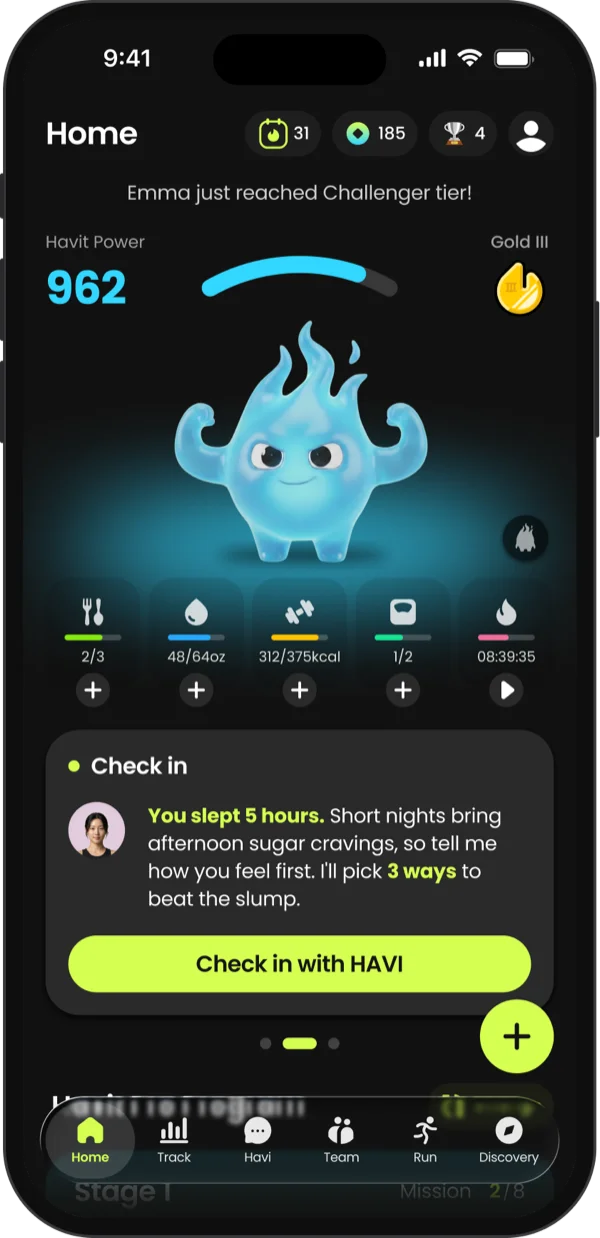
The HAVIT app includes guided meditation videos in five categories: Breathing & relaxation, Sleep, Focus & morning energy, Self-compassion & gratitude, and Cravings & appetite, which helps you steady your mind before meals to reduce impulsive eating and overeating. The Self-compassion & gratitude category is the natural home for the practices in this guide.
When you first get started, you can pick the meditation categories that interest you most. Because your meals, workouts, and sleep are logged in the same app, and the AI coach HAVI is right there too, it is easier to treat a heavy meal as one data point in a bigger picture rather than a reason to quit.
📊 Key Stats
Self-criticism vs. self-compassion after overeating
| Moment | Self-critical response | Self-compassionate response |
|---|---|---|
| Right after the meal | "I have no willpower." | "I ate more than I planned, and I feel uncomfortable." |
| That evening | Keep eating because the day is "ruined" | Drink water, take a short walk, close the kitchen |
| Next morning | Skip breakfast to make up for it | Eat a normal, balanced breakfast |
| Next week | "Start over on Monday" with strict rules | Continue your usual routine today |
Examples of how the two inner voices tend to play out. Choose the response that moves you toward your next healthy step.
❓ Frequently Asked Questions
What is self-compassion meditation?
Does self-compassion help with weight loss?
Won't being kind to myself make me lose motivation?
What should I do right after overeating?
How long should a self-compassion meditation be?
Is gratitude journaling or meditation actually effective?
What is HAVIT?
HAVIT is an AI health partner built on metabolic science — it protects your muscle, wakes up your metabolism, and helps you keep a healthy, rebound-free body for the long run.
Unlike calorie-only trackers, HAVIT connects AI body-composition estimates, nutrition, hydration, sleep, steps, cycle, mood, and GLP-1 medication in one daily routine — so progress is measured by body composition, not just the number on the scale. Daily missions turn established behavior-change techniques into small repeatable actions, drawing on expertise from professionals formerly at Juvis Diet, one of Korea’s leading metabolic clinics.
In HAVIT’s own analysis of 1,090 GLP-1 users, people who logged consistently built stronger habits than the general user base. Read the GLP-1 Habit Report
Inside the app
- AI COACHA coach that reads your day.
- WORKOUT & RUNNINGFrom home workouts to your next run.
- NUTRITIONLog meals in seconds.
- BODY INSIGHTSSee more than weight.
- DAILY MISSIONSBuild habits you can repeat.
- DAILY CHECK-INTell HAVI how today feels.
- TRACK EVERYTHINGFrom water to GLP-1
- MIND & RECOVERYFor the days willpower runs out.


HAVIT works with or without GLP-1 medication. It is a wellness app, not a medical device; body-composition results are estimates.

Continue in the App
Personalized wellness with your own data


References
- Self-compassion in weight management: A systematic review — Journal of psychosomatic research, 2021
- Effectiveness of self-compassion-related interventions for reducing self-criticism: A systematic review and meta-analysis — Clinical psychology & psychotherapy, 2022
- Stress, eating and weight change in first year students: the moderating role of self-compassion — Psychology & health, 2024
- Self-Compassion, Mindful Eating, Eating Attitudes and Wellbeing Among Emerging Adults — The Journal of psychology, 2022
- A meta-analysis of the effectiveness of gratitude interventions on well-being across cultures — Proceedings of the National Academy of Sciences of the United States of America, 2025