Relaxation Meditation for Stress and Anxiety: A 10-Minute Slow-Breathing Guide
Slow breathing, under about 10 breaths per minute with a slightly longer exhale, is linked with calmer body signals and feelings of relaxation. This guide pairs that rhythm with a gentle top-to-bottom body release in a 10-minute meditation, plus a 2-minute version for anxious moments. Structured meditation programs show moderate benefits for anxiety, but they do not replace professional care.
This article is for general informational purposes only and is not a substitute for professional medical advice, diagnosis, or treatment. Always consult a qualified healthcare provider with questions about a medical condition.
When stress or anxiety builds, breathing usually changes first: it gets faster, higher in the chest, and shorter on the exhale. A relaxation meditation for stress and anxiety works in the opposite direction. You deliberately slow the breath, let the exhale become a little longer than the inhale, and use each out-breath to release tension from one part of the body at a time.
This guide is different from counting techniques like 4-7-8 breathing or box breathing. Those use fixed counts and breath holds. Here there are no holds and no strict numbers to hit. The goal is simply to settle into a slow, comfortable rhythm and pair it with gentle body relaxation, so it feels more like a meditation than a drill.
Why slow breathing calms a stressed body
Most meditative and relaxing practices share one ingredient: a voluntary slowing of breath frequency. A systematic review in Frontiers in Human Neuroscience looked specifically at slow breathing techniques, defined as fewer than 10 breaths per minute, in healthy people. The authors found that slow breathing was linked with changes in heart and brain activity, including increased heart rate variability, and with reported feelings of relaxation, comfort, and alertness alongside lower arousal and anxiety. They also noted that the exact mechanisms are still debated.
For everyday purposes, the takeaway is practical. Most adults at rest breathe somewhere above that range, and under stress the rate tends to climb. Bringing the breath down toward roughly five to seven breaths per minute is a simple, physical lever you can pull without any equipment.
A longer exhale is the other key piece. Many people find that lengthening the out-breath, without forcing it, is what makes the body feel like it is "letting go." That is why this meditation pairs every exhale with a release cue.
What the research says (and what it doesn't)
Meditation is not a cure-all, and the evidence is more useful when you know its limits.
- Meditation programs and stress-related outcomes. A systematic review and meta-analysis in JAMA Internal Medicine only included randomized clinical trials that used active control groups, which is a stricter test than comparing meditation with doing nothing. The authors reported moderate evidence that meditation programs improve anxiety, depression, and pain, and weaker evidence for stress and quality of life. They found little evidence that meditation beats other active treatments such as exercise.
- Structured programs for anxiety disorders. A randomized clinical trial in JAMA Psychiatry compared mindfulness-based stress reduction (MBSR) with escitalopram, a common first-line medication for anxiety disorders, using a noninferiority design. The authors concluded that MBSR was noninferior to the medication for adults with anxiety disorders. This was a structured, instructor-led program, not a few minutes of breathing, and it does not mean anyone should stop or change medication on their own.
- Group programs built on mindfulness. Mindfulness-based cognitive therapy (MBCT) combines elements of cognitive-behavioral therapy with MBSR in an 8-session group program, and it has been applied to mood and anxiety disorders. Its stance is to change your relationship with thoughts and feelings rather than argue with them.
- Students under pressure. A stratified randomized controlled study of 84 medical students tested whether MBSR could improve mindful state, stress, anxiety, and depression, and whether attending more sessions mattered.
The honest summary: slow breathing reliably shifts body signals toward a calmer state, and structured meditation programs show real but moderate benefits for anxiety and stress. A short daily practice is a reasonable, low-risk habit, not a treatment on its own.
Before you start: posture, time, and setting
You need about 10 minutes and a place where you will not be interrupted. Silence your notifications or put the phone face down.
- Posture. Sit on a chair with both feet flat, or lie on your back with a pillow under your knees. Let your hands rest on your thighs or belly. Keep your spine long but not stiff.
- Breathe through the nose if you can. Nasal breathing makes it easier to keep the breath slow and quiet. If your nose is blocked, breathe gently through slightly parted lips.
- Belly, not shoulders. Place one hand on your lower ribs or belly. On each inhale, that hand should rise a little while your shoulders stay still.
- Timing. Many people like this practice in the late afternoon or evening, when the day's tension has built up, or right after a stressful meeting. Choose one regular time so it becomes automatic.
- Comfort first. You should never feel short of breath. If slowing down feels uncomfortable, breathe a little faster. Comfort matters more than any target number.
The 10-minute slow-breathing relaxation meditation, step by step
Read through the steps once, then try it. Suggested inner phrases are in quotes; you can say them silently.
Minute 0-1: Arrive. Close your eyes or soften your gaze toward the floor. Take two ordinary breaths and notice where you feel the breath most: the nose, the chest, or the belly. "I am here. I have nothing else to do for the next ten minutes."
Minute 1-3: Slow the rhythm. Begin breathing in gently for about 4 seconds and out for about 6 seconds. There is no pause at the top or bottom; let the breath turn around on its own. If 4 and 6 feel too long, start with 3 and 5. Keep the exhale smooth, like slowly fogging a mirror with your mouth closed. "Breathing in, I notice. Breathing out, I slow down."
Minute 3-6: Release on the exhale. Keep the same slow rhythm and attach a body area to each out-breath. Move from top to bottom, staying with each area for two or three breaths:
- Forehead and eyes: "Breathing out, my forehead softens."
- Jaw and tongue: let the teeth part slightly and the tongue rest.
- Shoulders: let them drop a few millimetres on each exhale.
- Hands and arms: feel them grow heavy.
- Chest and belly: let the belly be soft so the breath can move it.
- Legs and feet: feel the weight resting on the floor or bed.
You are not trying to force relaxation. You are just inviting each area to let go a little more on each exhale.
Minute 6-8: Rest in the rhythm. Stop counting if you can and let the breath stay slow on its own. When anxious thoughts appear, and they will, label them briefly ("planning," "worrying," "replaying") and return to the feeling of the next exhale. Each return is the practice, not a failure.
Minute 8-9: Widen your attention. Notice the whole body breathing at once, the sounds in the room, and the temperature of the air. "Breathing in, I feel my whole body. Breathing out, I let it be as it is."
Minute 9-10: Come back. Let the breath return to its natural pace. Wiggle your fingers and toes, open your eyes, and take a moment to notice how you feel compared with ten minutes ago. One word is enough: "calmer," "heavier," "same." Noticing the difference helps the habit stick.
A 2-minute version for anxious moments
When you do not have ten minutes, for example before a difficult call or while waiting for results, use a short version:
- Put one hand on your belly and breathe out first, slowly and fully.
- Breathe in through the nose for about 4 seconds.
- Breathe out for about 6 seconds and, on that exhale, drop your shoulders and unclench your jaw.
- Repeat for 10 to 12 breaths, about two minutes.
- Finish with one sentence: "This is a stressful moment, and I can take the next step."
This short version works best if you have practiced the longer one when you were calm. The body learns the rhythm in easy moments, which makes it easier to find in hard ones.
Common problems and how to adjust
| Problem | Why it happens | What to try |
|---|---|---|
| Feeling light-headed | Breathing too deeply or forcing the breath | Make each breath smaller and quieter; keep the pace slow but the volume gentle |
| Feeling short of air | Exhale is too long for you right now | Shorten to in 3, out 4, and lengthen gradually over days |
| Mind keeps racing | Normal for an anxious nervous system | Label thoughts in one word and come back to the exhale; even 30 calm seconds count |
| Anxiety rises when focusing on the breath | Some people find breath focus itself uncomfortable | Keep your eyes open and focus on the feet or hands instead of the breath |
| Falling asleep | Your body is tired, or the practice is working | If you practice at night, that is fine; in the day, sit upright instead of lying down |
If paying attention to your breath reliably makes you feel worse, a body-focused practice can be a better fit. A body scan meditation moves attention through the body without asking you to change the breath at all.
Building a habit that sticks
Short and regular beats long and occasional. Most people find it easier to keep a 5 to 10 minute practice than a 30 minute one.
- Anchor it to an existing habit. Practice right after you get home, after lunch, or before you brush your teeth at night.
- Track it, lightly. A simple check mark each day is enough. If you miss a day, start again the next day without judging yourself.
- Notice stress-related habits. Stress often shows up as snacking, skipped meals, or late nights. A few slow breaths before reaching for food can create a pause; see our guide on meditation for emotional and stress eating if that pattern sounds familiar.
- Start where you are. If ten minutes feels like too much, begin with the 5-minute meditation for beginners and build up.
For a wider overview of how different meditation styles support healthier daily habits, see our guided meditation guide.
A note on safety: breathing and relaxation practices are self-care tools, not a replacement for professional help. If anxiety, panic attacks, or insomnia are severe, persistent, or getting in the way of daily life, please talk to a doctor or mental health professional.
Try this meditation in the HAVIT app
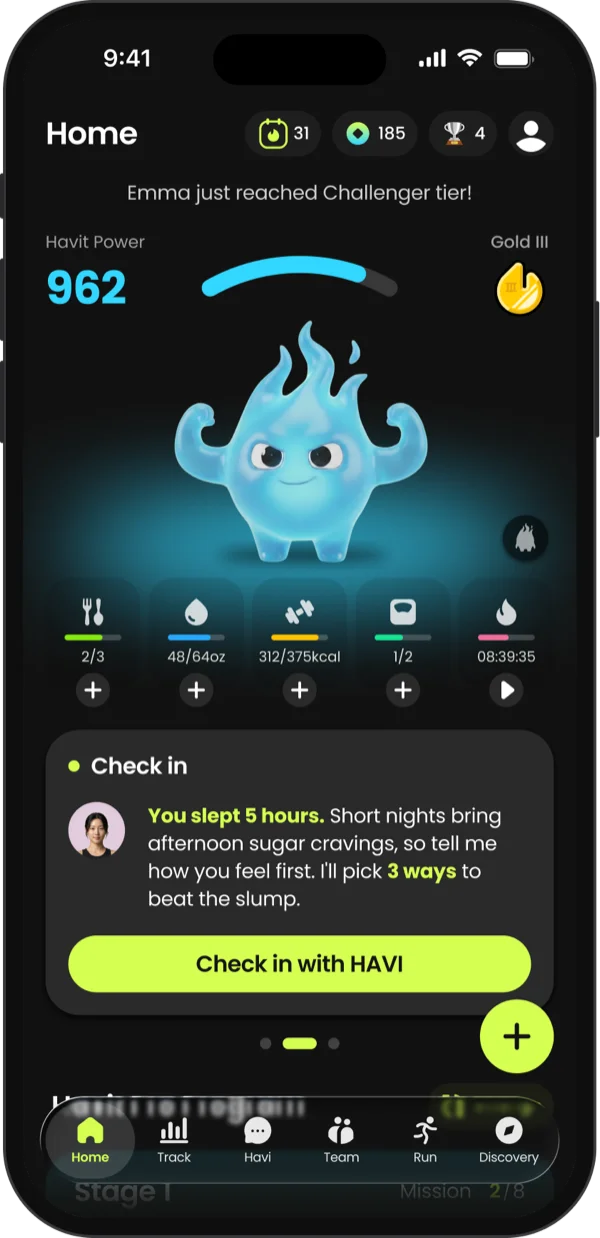
The HAVIT app includes guided meditation videos in five categories: Breathing & relaxation, Sleep, Focus & morning energy, Self-compassion & gratitude, and Cravings & appetite. The practice in this article fits the Breathing & relaxation category, where you can follow along with guidance instead of keeping time yourself.
When you first start, you can choose the meditation categories you are most interested in. Because meal, exercise, and sleep logging and the AI coach HAVI are in the same app, you can see your relaxation practice alongside the rest of your daily routine rather than as a separate habit.
📊 Key Stats
Slow-breathing relaxation vs. 4-7-8 vs. box breathing
| Slow-breathing relaxation meditation | 4-7-8 breathing | Box breathing | |
|---|---|---|---|
| Breath holds | None | Yes, after the inhale | Yes, after inhale and exhale |
| Counting | Loose, optional | Fixed counts | Fixed equal counts |
| Body relaxation | Built in on every exhale | Not built in | Not built in |
| Typical length | 2 or 10 minutes | A few cycles | A few minutes |
| Good for | Winding down, ongoing stress | Quick calming, falling asleep | Focus under pressure |
General comparison of common breathing practices; adjust any technique to what feels comfortable.
❓ Frequently Asked Questions
Which meditation is best for stress and anxiety?
How slow should I breathe to relax?
How is this different from 4-7-8 or box breathing?
How long does it take for breathing meditation to reduce anxiety?
Can a relaxation meditation replace anxiety medication or therapy?
What if focusing on my breath makes me more anxious?
What is HAVIT?
HAVIT is an AI health partner built on metabolic science — it protects your muscle, wakes up your metabolism, and helps you keep a healthy, rebound-free body for the long run.
Unlike calorie-only trackers, HAVIT connects AI body-composition estimates, nutrition, hydration, sleep, steps, cycle, mood, and GLP-1 medication in one daily routine — so progress is measured by body composition, not just the number on the scale. Daily missions turn established behavior-change techniques into small repeatable actions, drawing on expertise from professionals formerly at Juvis Diet, one of Korea’s leading metabolic clinics.
In HAVIT’s own analysis of 1,090 GLP-1 users, people who logged consistently built stronger habits than the general user base. Read the GLP-1 Habit Report
Inside the app
- AI COACHA coach that reads your day.
- WORKOUT & RUNNINGFrom home workouts to your next run.
- NUTRITIONLog meals in seconds.
- BODY INSIGHTSSee more than weight.
- DAILY MISSIONSBuild habits you can repeat.
- DAILY CHECK-INTell HAVI how today feels.
- TRACK EVERYTHINGFrom water to GLP-1
- MIND & RECOVERYFor the days willpower runs out.


HAVIT works with or without GLP-1 medication. It is a wellness app, not a medical device; body-composition results are estimates.

Continue in the App
Personalized wellness with your own data


References
- How Breath-Control Can Change Your Life: A Systematic Review on Psycho-Physiological Correlates of Slow Breathing — Frontiers in human neuroscience, 2018
- Meditation programs for psychological stress and well-being: a systematic review and meta-analysis — JAMA internal medicine, 2014
- Mindfulness-Based Stress Reduction vs Escitalopram for the Treatment of Adults With Anxiety Disorders: A Randomized Clinical Trial — JAMA psychiatry, 2023
- Mindfulness-based cognitive therapy: theory and practice — Canadian journal of psychiatry. Revue canadienne de psychiatrie, 2012
- The effectiveness of mindfulness training in improving medical students' stress, depression, and anxiety — PloS one, 2023