Body Scan Meditation for Sleep: A 10-Minute Step-by-Step Script
A body scan is a slow, guided tour of attention from your toes to the top of your head, and it is one of the core practices in mindfulness programs that researchers have tested for sleep. Below is a 10-minute script you can follow in bed, with timings, breathing cues and example phrases. If insomnia is persistent or severe, treat this as a complement to professional care, not a replacement.
This article is for general informational purposes only and is not a substitute for professional medical advice, diagnosis, or treatment. Always consult a qualified healthcare provider with questions about a medical condition.
Why a body scan fits the last ten minutes of your day
Most nights, the problem is not that the body refuses to sleep. It is that the mind keeps working: replaying a conversation, rehearsing tomorrow, checking the clock and calculating how many hours are left. The harder you try to switch that off, the more alert you tend to feel.
A body scan gives the mind a different job. Instead of fighting thoughts, you move your attention slowly through the body, region by region, simply noticing what is there: warmth, weight, tingling, tension, the contact of skin against the sheet. You are not trying to relax each part on command. You are practicing noticing without fixing, which is the same skill mindfulness programs teach.
Three features make it well suited to bedtime:
- It is lying-down friendly. You do not need to sit upright or keep your eyes open. You can do it exactly where you intend to sleep.
- It has a built-in structure. Feet, legs, hips, belly, chest, hands, arms, shoulders, neck, face. When you drift, you always know where to come back to.
- It turns "trying to sleep" into "paying attention." Sleep usually arrives when effort stops. A body scan replaces effort with a simple, low-stakes task.
If you fall asleep before you reach your head, the practice did its job. There is no prize for finishing.
What the research says (and what it does not)
Body scanning is a standard component of mindfulness-based stress reduction (MBSR), a structured program that also includes sitting meditation and gentle movement. Several studies have looked at mindfulness programs and sleep:
- A systematic review and meta-analysis of randomized controlled trials pooled 18 trials with 1,654 participants to estimate how mindfulness meditation affects sleep quality. Importantly, it compared mindfulness against two kinds of control: established sleep treatments, and time- and attention-matched activities designed to account for placebo effects.
- A three-arm randomized trial in 54 adults with chronic insomnia compared MBSR, a mindfulness-based therapy adapted specifically for insomnia, and an eight-week self-monitoring condition, tracking wake time from sleep diaries, pre-sleep arousal and insomnia severity.
- A randomized clinical trial in older adults with moderate sleep disturbances (mean age 66.3, Pittsburgh Sleep Quality Index above 5) tested a standardized mindful awareness practices program as a community-accessible option.
- Focus groups with 18 adults who completed an 8-week MBSR program explored how participants themselves experienced the changes in their sleep. The authors note that chronic insomnia affects roughly 10% of adults and that mindfulness training may be an effective approach.
What this evidence does not show is that one 10-minute body scan will cure insomnia. The programs studied ran for weeks and combined several practices. For chronic insomnia, a systematic review commissioned by the American Academy of Sleep Medicine evaluated behavioral and psychological treatments to support clinical guidelines, and structured approaches delivered by trained clinicians remain the first place to look. Think of the nightly body scan as a skill-building habit that supports good sleep, not a medical treatment.
Set up before you begin
A few small choices make the scan easier to follow and less likely to be interrupted.
Timing. Start once you are in bed with the lights off, or nearly off. If you like, set a quiet 10-minute timer, but many people prefer no timer at all so there is nothing to wait for.
Position. Lie on your back with arms slightly away from your sides, palms up or resting on your belly. Put a pillow under your knees if your lower back feels tight. If lying on your back is uncomfortable, lie on your side; the scan works in any position.
Screens. Put your phone face down and out of reach, or use audio-only guidance with the screen off.
Intention. Say to yourself, silently: "For the next ten minutes, my only job is to notice." That sentence takes the pressure off falling asleep.
If your body feels wound up after a long day, a few minutes of gentle movement first can help; see this evening stretching routine for falling asleep.
The 10-minute body scan script, minute by minute
Read this through once in daylight so you know the order. At night, you do not need to remember the exact words; the sequence matters more than the script.
Minute 0–1: Arrive and breathe. Let your eyes close. Take three slow breaths: in through the nose for about four counts, out through the mouth for about six. Let the exhale be a little longer than the inhale. Then let the breath return to its own rhythm. Say silently: "Breathing in, I notice I'm here. Breathing out, I let the bed hold me."
Minute 1–2: Feet. Bring attention to your toes. Notice whatever is there: warmth, coolness, the weight of the blanket, or nothing at all. "Nothing" is a valid observation. Move to the soles, the heels, the tops of the feet. "Toes… soles… heels. Just noticing."
Minute 2–3: Lower legs and knees. Let attention drift up into the ankles, calves and shins, then the knees. If you find tension, you do not need to release it. Breathe toward it, as if the exhale could travel down there. "Calves heavy. Knees soft."
Minute 3–4: Thighs and hips. Notice the backs of the thighs pressing into the mattress. Feel the width of the hips and the weight of the pelvis. This is a large area; take your time and let it sink.
Minute 4–5: Belly and lower back. Rest attention on the belly rising and falling. Do not change the breath; just watch it. Notice the lower back and where it touches, or doesn't touch, the bed. "Belly rising… belly falling."
Minute 5–6: Chest and upper back. Feel the ribs widen gently on the inhale. Notice the heartbeat if it is easy to feel; if not, simply notice the chest. Sense the shoulder blades resting against the mattress.
Minute 6–7: Hands and arms. Move to the fingertips, then the palms, the backs of the hands, wrists, forearms, elbows and upper arms. Many people notice a tingling or pulsing in the hands; let it be there. "Fingers… palms… arms heavy."
Minute 7–8: Shoulders and neck. This is where many of us carry the day. Notice the shoulders. On the next exhale, imagine them sliding a centimeter away from the ears. Let the back of the neck lengthen against the pillow.
Minute 8–9: Face and head. Soften the jaw and let the teeth part slightly. Let the tongue rest. Notice the cheeks, the eyes resting in their sockets, the forehead, the scalp. "Jaw loose. Eyes soft. Forehead smooth."
Minute 9–10: Whole body. Widen attention to the entire body at once, lying here, breathing. If you are still awake, stay with the feeling of the whole body being supported. You don't need to get up or "finish." "Nothing to do. Nowhere to go. Just resting."
If you are still awake at the end, you can either start again at the feet more slowly or simply keep resting in whole-body awareness until sleep arrives.
When your mind races, or you wake at 3 a.m.
Thoughts keep pulling you away. That is normal and expected. Each time you notice you have drifted, silently label it ("planning," "worrying," "remembering") and return to the last body part you remember. The return is the practice; there is no such thing as a failed scan.
You feel more alert, not less. Some people find that focusing on the body makes them notice discomfort or a racing heart. Try keeping your eyes slightly open, scanning faster (about 30 seconds per region), or anchoring on the breath first with a calming pattern such as 4-7-8 breathing before you begin the scan.
You wake in the middle of the night. Skip the clock. Start a shortened scan: feet, belly, hands, face, whole body, roughly two minutes each. Repeat as many rounds as you like.
Anxiety is the main obstacle. If worry, not tension, is what keeps you up, pair the scan with a dedicated breathing and relaxation meditation for stress earlier in the evening.
If you have had trouble falling or staying asleep on most nights for several weeks, or if sleep problems come with low mood, heavy anxiety or loud snoring, please talk to a doctor or a sleep specialist. Meditation can support care, but it is not a substitute for diagnosis and treatment.
Making it a nightly habit
The studies above tested programs that lasted weeks, not single sessions. Consistency is what turns the body scan from a nice idea into a reliable cue for winding down.
- Attach it to something you already do. Teeth brushed, lights off, body scan. Same order every night.
- Keep the bar low. On difficult nights, a three-minute version (feet, belly, face) still counts.
- Notice the next morning, not the night. Instead of judging how fast you fell asleep, check in the morning: did the evening feel calmer? Small trends over a couple of weeks are more informative than any single night.
- Combine it with the basics. A regular wake-up time, daylight in the morning, and less caffeine late in the day all make the scan's job easier.
If you want to see where the body scan fits among other practices, our guide to meditation for healthy habits maps out which meditation suits which moment of the day.
Try this meditation in the HAVIT app
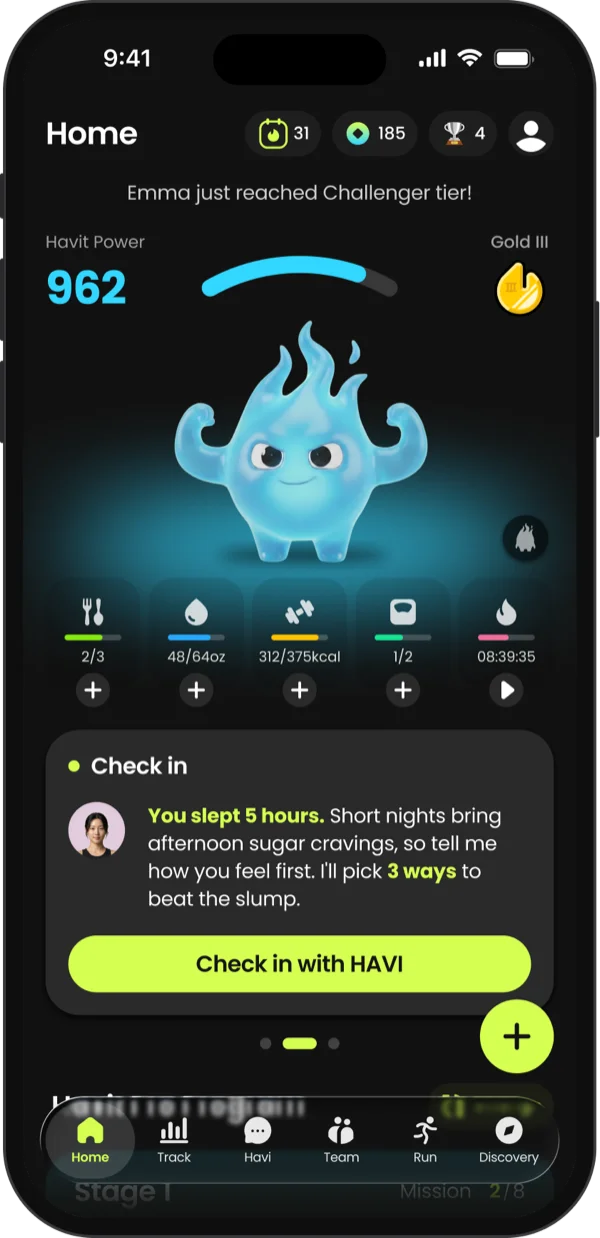
The HAVIT app includes guided meditation videos organized into five categories: Breathing & relaxation, Sleep, Focus & morning energy, Self-compassion & gratitude, and Cravings & appetite. If bedtime is your hardest moment, start with the Sleep category. When you first set up the app, you can choose the meditation categories you are most interested in, and your meals, workouts and sleep logs live in the same place alongside HAVI, the AI coach. That makes it easier to notice how your evening routine and your sleep relate over time, without switching between apps.
📊 Key Stats
Choosing a version of the body scan
| Version | Time | Best for | Regions covered |
|---|---|---|---|
| Full scan | 10 minutes | Regular bedtime wind-down | Feet to head, then whole body |
| Short scan | 3 minutes | Very tired or late nights | Feet, belly, face |
| Night-waking scan | About 10 minutes, repeatable | Waking at 3 a.m. | Feet, belly, hands, face, whole body |
| Fast scan, eyes slightly open | 5 minutes | When focusing on the body feels uncomfortable | All regions, about 30 seconds each |
Practical variations based on the script in this guide; adjust timing to what feels comfortable.
❓ Frequently Asked Questions
Does body scan meditation actually help you fall asleep?
How long should a body scan for sleep be?
Is it okay if I fall asleep during the body scan?
What should I do if my mind keeps wandering?
Should I do a body scan lying down or sitting up?
Can a body scan replace treatment for insomnia?
What is HAVIT?
HAVIT is an AI health partner built on metabolic science — it protects your muscle, wakes up your metabolism, and helps you keep a healthy, rebound-free body for the long run.
Unlike calorie-only trackers, HAVIT connects AI body-composition estimates, nutrition, hydration, sleep, steps, cycle, mood, and GLP-1 medication in one daily routine — so progress is measured by body composition, not just the number on the scale. Daily missions turn established behavior-change techniques into small repeatable actions, drawing on expertise from professionals formerly at Juvis Diet, one of Korea’s leading metabolic clinics.
In HAVIT’s own analysis of 1,090 GLP-1 users, people who logged consistently built stronger habits than the general user base. Read the GLP-1 Habit Report
Inside the app
- AI COACHA coach that reads your day.
- WORKOUT & RUNNINGFrom home workouts to your next run.
- NUTRITIONLog meals in seconds.
- BODY INSIGHTSSee more than weight.
- DAILY MISSIONSBuild habits you can repeat.
- DAILY CHECK-INTell HAVI how today feels.
- TRACK EVERYTHINGFrom water to GLP-1
- MIND & RECOVERYFor the days willpower runs out.


HAVIT works with or without GLP-1 medication. It is a wellness app, not a medical device; body-composition results are estimates.

Continue in the App
Personalized wellness with your own data


References
- The effect of mindfulness meditation on sleep quality: a systematic review and meta-analysis of randomized controlled trials — Annals of the New York Academy of Sciences, 2019
- A randomized controlled trial of mindfulness meditation for chronic insomnia — Sleep, 2014
- Mindfulness meditation and improvement in sleep quality and daytime impairment among older adults with sleep disturbances: a randomized clinical trial — JAMA internal medicine, 2015
- Behavioral and psychological treatments for chronic insomnia disorder in adults: an American Academy of Sleep Medicine systematic review, meta-analysis, and GRADE assessment — Journal of clinical sleep medicine : JCSM : official publication of the American Academy of Sleep Medicine, 2021
- How mindfulness changed my sleep: focus groups with chronic insomnia patients — BMC complementary and alternative medicine, 2014